Society
For love or money
By Chihua Wen (China Daily)
Updated: 2010-08-04 07:56
 |
Large Medium Small |
Attitudes to love and marriage continue to change since the first Marriage Law was introduced in 1950, and have to play catch-up with people's evolving love lives since then.
Wu Bo, the 55-year-old mother of a 23-year-old unwed son, was taken aback when Ma Nuo, 22, a model from Beijing said on China's most popular TV reality program Don't Bother Me: "I'd rather weep in a BMW than smile on the bicycle of my true love."
"I don't like to generalize, but Ma's words show that young women today worship money. They won't get married unless their boyfriends have a house and a car. They're so mercenary," Wu says.
|
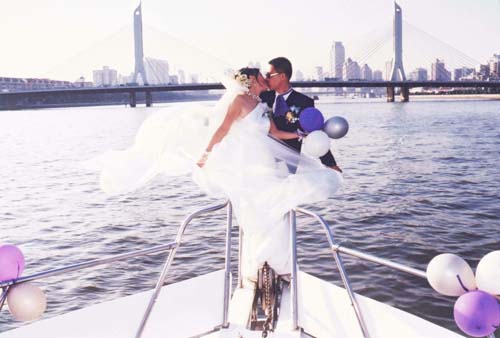 A luxurious wedding held on a yacht in Guangzhou in 2001. A wedding often costs tens of thousands yuan. Photos from China Photo Press |
A civil servant in Chengdu, Wu remembers her own younger days in the 1980s as being rosy and romantic.
"Material success was not so important to my generation. Most of my peers wanted to find a mate who was a spiritual match more than one who was materially rich."
"Being materialistic is not our fault. Our whole society is already that way," says Sun Mei, 24, a project officer with a Canadian company in Beijing.
|
||||


"Ideas of marriage and Chinese values have taken three sharp turns over the last 60 years since the first Marriage Law was promulgated on May 1, 1950," says Chen Mingxia, a professor with the Institute of Law of Chinese Academy of Social Sciences.
The Marriage Law gave people the freedom to marry who they wanted and banned such practices as multiple wives, concubines, child marriages, and the bride price.
"The freedom to marry was one of the most significant signs of social change in the 1950s," says Chen.
Hu Yongquan, 83, was born to a wealthy landlord and his first marriage was arranged. However, in 1952 armed with the Marriage Law, Hu divorced his first wife from his arranged marriage and married Lin, the woman he loved, who was from a merchant family.
"My father threatened to disown me if I married her, and when her father learned we were dating, he locked her up. But I told my father, 'It's a new society now. Everyone has the freedom to choose their own partner'. We lived happily after that," says Hu.
Yu Ma, 52, an antique dealer from Chongqing, recalls that his first two girlfriends both left him because his father was denounced as a rightist in 1958.
"Their parents worried that my politically-stained family would damage their future," he says.
In those years, in addition to the parents' approval, couples had to seek the approval of the authorities at their workplace, or from the neighborhood committee before they could get married.
While the freedom to marry for love had become socially acceptable, divorce was not. As in marriage, couples had to get the permission of authorities before they could divorce.