CHINA> National

|
CHINA> National
|
|
China tries to make officials see green
By Fu Jing (China Daily)
Updated: 2009-07-06 08:24 China's leadership recently decided to assess the performance of government officials not just by how fast they managed to spur economic growth but also by the environmental soundness of that growth. ,k
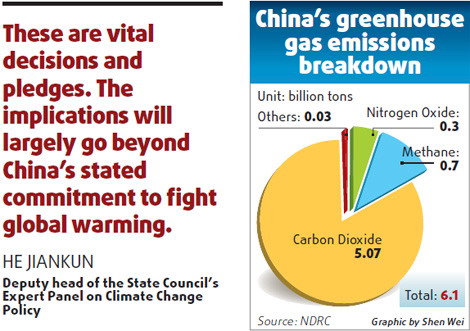
In early June, Premier Wen Jiabao affirmed that China would put in place carbon emissions reduction targets in national development programs. In other words, China would assess its economic performance by how much less carbon it would emit per unit of GDP growth. Experts believed the decision and announcement had "ample policy implications". They said that once commitment was translated into action, China would accelerate the pace of restructuring its energy mix and economic structure, and seek a "green recovery path" out of a worsening financial crisis. "These are vital decisions and pledges. The implications will largely go beyond China's stated commitment to fight global warming," He Jiankun, deputy head of the State Council's Expert Panel on Climate Change Policy told China Business Weekly during an exclusive interview recently.
If that were the case, China would enter a new era in terms of climate change policy compared with its 20-percent energy saving target for the 11th Five-Year Plan (2006-10). "To reduce carbon intensity, we should focus on low-carbon technologies and clean solutions," He said. "That will be the new economic engine for China's further growth." China is expected to witness steady economic recovery when its GDP likely climbs to 8 percent after the current economic downturn. Vice-Premier Li Keqiang has repeatedly voiced the central government's desire to find new growth points to sustain economic development. Li has pinned high hopes on efforts to tackle climate change, develop clean energy and strengthen environmental protection. "If we take action on all these fronts, then it can help us shake off the negative impact of the global recession," he has said.
Liu said that new energy programs would involve investment of trillions and that new energy output was likely to exceed the targets set by the nation's overall energy and renewable energy plans. |
泗洪县| 延寿县| 南昌县| 临桂县| 榕江县| 黎平县| 习水县| 绵阳市| 潮安县| 萍乡市| 开原市| 宁蒗| 疏附县| 江达县| 中山市| 蒙阴县| 伊金霍洛旗| 盐源县| 商河县| 兴安盟| 吉隆县| 阳谷县| 万全县| 理塘县| 德化县| 商南县| 京山县| 塘沽区| 溆浦县| 客服| 博罗县| 三河市| 涟源市| 涞源县| 衡阳市| 阿克| 垦利县| 卓尼县| 枞阳县| 甘洛县| 城步|