UN program attendees in Beijing cite vehicles' contribution to dirty air.
 |
|
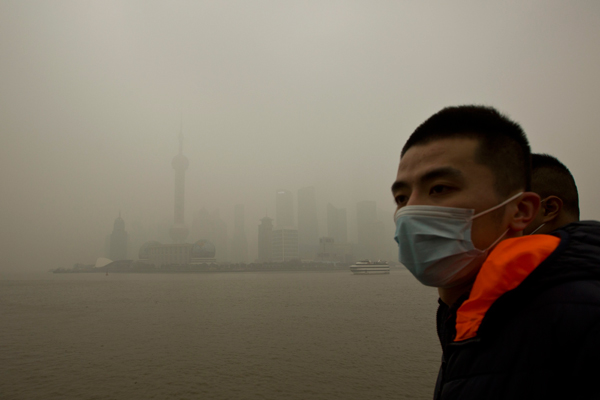
A man wears a face mask while walking on the Bund in front of the financial district of Pudong during a hazy day in downtown Shanghai Dec 9, 2013.[Photo/Agencies] |
More than 100 cities were shrouded in thick smog and haze for the past week. National alarms for smog and haze that lasted for seven days were not lifted until Monday morning, according to the National Meteorological Center.
"Emissions from motor vehicles contribute a significant part to air pollution, sometimes as high as 50 percent, especially in such foggy weather when the air is stagnant," said Lu Shize, air pollution section chief from the Pollution Prevention and Control Department of the Environmental Protection Ministry.
Lu was speaking at the International Workshop on Motor Vehicle Fuel Desulfurization, held by the United Nations Environment Programme in Beijing on Monday.
Two standards systems, one for emissions and the other for fuel, control the pollution coming from motor vehicles.
China should start to prepare for its new China VI emissions standard, which may further reduce the amount of pollutants discharged by motor vehicles by another 40 percent based on the latest China V standard, said Ding Yan, deputy head of the ministry's vehicle emission control center.
The Beijing government has vowed to implement the new standard by 2016 at the earliest.
"There has been criticism of the government for being radical in promoting the development of emissions and fuel standards over the past decade, trying to reach a similar level as developed countries in such a short time," Ding said.
"But seen from the perspective of environmental protection, we are being too slow by following the developed countries' steps, when their pollution levels are already much lower than China's."
Research shows that China's latest fuel standard is behind those of Europe and the United States, and has much room for improvement.
The sulfur content of gasoline was lowered four times in 10 years, with the allowed content dropping from 1,000 microgram per gram to the current 50 mcg per gram.
However, the desulfurization of diesel is occurring at a very slow pace, with its allowed sulfur content reduced to 350 mcg per gram nationwide on July 1 from the previous level of as high as 2,000 mcg per gram, which lasted for more than 10 years.
The permitted sulfur level for diesel in the European standard is 10 mcg per gram.
"Limits for contents of other pollutants in our gasoline standard, such as olefin and aromatics, are too high, leading to more emissions of toxic particulate matters and complex airborne pollution," said Tong Li, associate professor at the ministry's appraisal center for environment and engineering.
Tong added that the high vapor pressure limit in the country's gasoline standard, which is twice the US standard, may cause high emissions of volatile organic pollutants.
Setting up stricter emission and fuel standards does not necessarily mean higher costs, according to studies and foreign experience.
"Introducing cleaner fuels and vehicles is considered one of the most cost-effective air pollution and climate change interventions, because it has climate and health benefits plus provides major cost savings," said Zhang Shigang, coordinator of the UNEP China Office.
The average per-liter cost to upgrade refineries and produce 10-mcg-per-gram sulfur fuel in China is 0.7 cents for gasoline and 1.7 cents for diesel. This is well below the price increases approved in October 2013 by the National Development and Reform Commission, according to analysis commissioned by the International Council on Clean Transportation, an international nonprofit research organization based in Washington.
The analysis also found that the long-term benefits of the proposed China VI standards outweigh the costs by at least 7-to-1.
The sales volume of motor vehicles in China is expected to reach 22 million in 2013, while the International Council on Clean Transportation predicts the number of vehicles in the nation will reach almost 200 million by 2030, with more than 40 percent of those in the Beijing-Tianjin-Hebei cluster, the Yangtze Delta and the Pearl River Delta, the three most polluted areas in China.
"Higher emissions and fuel standards help trap 99 percent of diesel particles, and filters should belong on tailpipes, not people," said Vance Wagner, senior researcher and China co-lead of the council.

|
|
|
|
|
|
|
|

Copyright 1995 - . All rights reserved. The content (including but not limited to text, photo, multimedia information, etc) published in this site belongs to China Daily Information Co (CDIC). Without written authorization from CDIC, such content shall not be republished or used in any form. Note: Browsers with 1024*768 or higher resolution are suggested for this site.
License for publishing multimedia online 0108263 Registration Number: 130349 

















 Raymond Zhou
 Op Rana
 Berlin Fang
 Zhu Yuan
 Huang Xiangyang
 Chen Weihua