|
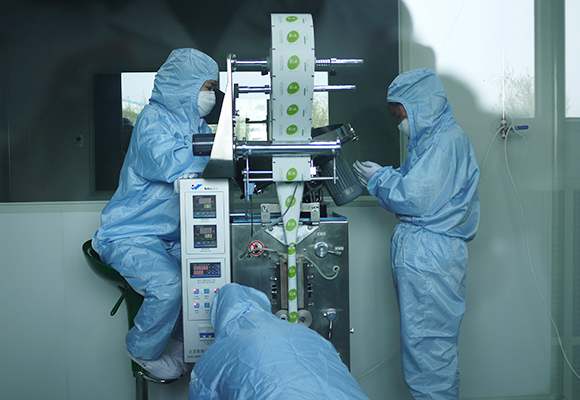 Workers package finished spirulina products at a workshop within the China Inner Mu Biomass Power Company in Erdos, the Inner Mongolia autonomous region, Oct 20, 2013. [Photo by He Yini / chinadaily.com.cn] |
"The social benefits of the new economic model are huge; there's no doubt about that. But in the end, the company has to find a way to make money in order to survive," said He Jiankun, president of the Institute of Low Carbon Economy of Tsinghua University.
The company is expecting a break-even balance sheet next year given the fact that the market is starting to recognize the company and its products, thus cutting the company's deficit to about 10 million yuan this year from 40 million yuan four years ago.
Continuing efforts
"Selling spirulina is not the end; it's just a means to the end," said Li Jinglu, the company's chairman. "The thing is, desert control is a huge undertaking, and it is not within the power of a mere company."
Li said he has spent ten years struggling all along the way until an economic model that is green, low-carbon, circular and sustainable takes shape.
|
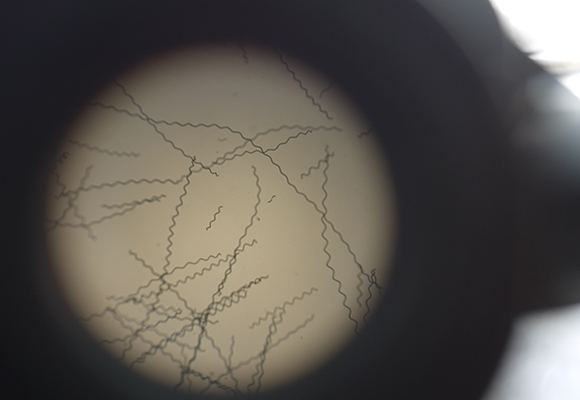 Spirulina is seen under microscope at one of the company's laboratories in Erdos, Oct 20, 2013. [Photo by He Yini / chinadaily.com.cn] |
"The model is unique, and viable in desert control. More importantly, it can improve the well-being of local people, and spur local economy," said Jiang Minlin, an official with the State Council, when visiting the Maowusu desert and the factory, a field trip initiated by IEEPA.
Jiang added that it is within reason for the model to win support from the Chinese government and to be extended to other desert areas and provide more benefits.
Desertification has long been an ecological problem in China, and a big headache for the Chinese government. Statistics show that more than 1.7 million km2 of the country's territory is now covered by desert, 40 percent of which has aquifers that makes desert control not only possible but much easier.
China has been stepping up efforts on afforestation, desert control, and carbon emissions reduction, in a bid to spur its green transformation amid urbanization and economic restructuring. The country plans to cut carbon emissions relative to GDP by 40 to 45 percent by 2020, compared with 2005 levels.
Guan Minjie, an official with the Ministry of Agriculture, said: "We have to standardize each link of the new economic model to make it big and reproducible nationwide. Only in this way can it become a boon for China and beyond."
"Desert control is part of our Chinese Dream," said Li Junyang, general secretary of IEEPA. "The road ahead is bumpy. But once the chained industry takes off, that dream will naturally come true."


Copyright 1995 - . All rights reserved. The content (including but not limited to text, photo, multimedia information, etc) published in this site belongs to China Daily Information Co (CDIC). Without written authorization from CDIC, such content shall not be republished or used in any form. Note: Browsers with 1024*768 or higher resolution are suggested for this site.
License for publishing multimedia online 0108263 Registration Number: 130349