Comments()
  Print
Print  Mail
Mail  Large Medium Small
 |
|
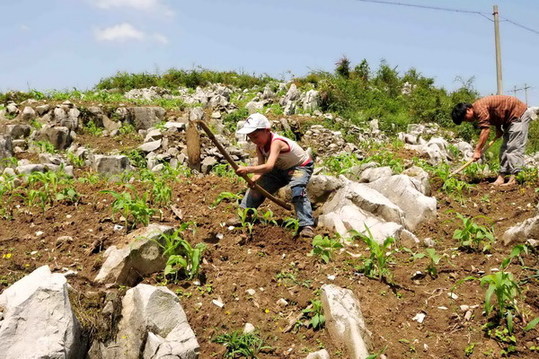
Farmers plant corn in a stony desert area in Huishui county, Guizhou province. [Photo/China Daily] |
Millions of hectares of stony desert areas prevail in parts of South and Southwest China, posing great threats to the environment of the Yangtze and Pearl rivers, two of the country's main waterways, officials said.
The country's stony desert areas shrank to 12 million hectares by the end of 2011, down 7.4 percent from 2005, according to the latest monitoring results released by the State Forestry Administration.
The spread of stony deserts has been brought under control and the areas have been shrinking at an annual rate of 1.27 percent over the past few years, according to Zhang Yongli, deputy director of the administration, on Thursday.
"However, the country still faces severe challenges in fighting desertification as the spread of stony deserts continues due to the impact of climate change," he said.
For instance, with successive years of drought, stony desert areas now spread at an annual rate of 6.8 percent in Qujing, Yunnan province, a major headwater area of the Pearl River, according to the administration.
Of the 12 million hectares of stony desert areas, nearly 65 percent were in Guizhou, Yunnan, and Guangxi, regions frequently hit by drought and flood in recent years, Zhang said.
The country's stony desert areas now threaten the headwater areas of the Pearl River, major tributaries of the Yangtze River, as well as water source of the South-to-North Water Diversion Project and the Three Gorges reservoirs, according to the administration.
"The stony desert areas with water loss and soil erosion cause sand deposits in the lower reaches of the rivers, which pose great threats to the local environment, as well as to lives and properties along the rivers," he said.
Forestry officials said forestation and vegetation protection, as well as the application of modern agricultural technologies, contributed a lot to the ecological restoration in the stony desert regions.
At present, more than 50 million people live in the rocky regions, where desertification has resulted from water shortages, soil erosion and persistent poverty, according to the administration.
"Stony desertification and poverty are like 'twin brothers', so we combined the work to control stony desertification with the efforts to improve local people's livelihoods," said Liu Tuo, head of the Desertification Control Center under the State Forestry Administration.
Farmers had been encouraged to grow cash crops on stony lands to improve vegetation and increase earnings, he said.
Li Maosong, a researcher on disaster reduction at the Chinese Academy of Agricultural Sciences, told China Daily on Thursday that destructive farming practices, excessive land reclamation and overgrazing still exist in some rocky regions.
"For instance, farming on steep hills is quite common in those areas because of a lack of arable land, which caused severe soil erosion and speeds up the spread of stony deserts," he said.
"Government authorities should continue to increase investment in local environmental improvement and give more subsidies to support local farmers to avoid destructive farming practices," he said.
Stony desert areas are big problems in eight provinces, autonomous regions, and municipalities, such as Hunan, Guangdong, Guangxi, Chongqing and Yunnan, according to the State Forestry Administration.
jinzhu@chinadaily.com.cn

 Michelle Obama addresses at Democratic National Convention
 Slides of Yanbian: place, people and prosperity
 Washington to remain focused on Asia-Pacific
 RQFII target blue chips amid bear market
 Australian recall for top two exporters
 China fears new car restrictions
Copyright 1995 - 2010 . All rights reserved. The content (including but not limited to text, photo, multimedia information, etc) published in this site belongs to China Daily Information Co (CDIC). Without written authorization from CDIC, such content shall not be republished or used in any form. Note: Browsers with 1024*768 or higher resolution are suggested for this site.
License for publishing multimedia online 0108263 Registration Number: 20100000002731