"We've been living in Beijing for more than 10 years, but we still don't feel as though we belong here or are part of the city. We had planned to buy a house and stop moving from district to district, but the longer we stay, the more desperate we become. The only way we can hope to become Beijingers now is if my daughter can find a Beijing husband with property," he said with a bitter smile.
"I have often dreamed that one day I would take my wife and daughter back to our home village in glory. But now I think it may never happen," he said.
Two-tier system
|
What's in a name? There's a tradition in China, whereby children are often named after major events. For example, many women in their 50s who were born just after the Korean War (1950-53) have the name Kangmei, which means "Anti-United States", while many men bear the name Yuanchao, which means "Aiding the Democratic People's Republic of Korea". The tradition survives in many parts of China, especially in Sichuan province where a newborn girl brought a new dimension to the practice in 2006. She was named after the New Rural Cooperative Medical Care System, called Xin Nong He in pinyin - the system by which Chinese characters are rendered in the Roman alphabet. The girl's mother Wang Haifang attended Jiange county health center for a pre-natal examination on Jan 1, 2006. She had planned to give birth at home to save on medical bills, but the doctor told her she would be eligible to reimbursement of 100 yuan ($16) if she participated in the NCMS. Wang registered at once and her daughter was born the following morning. Because she was the first child born after the county joined the NCMS, her grandfather suggested calling her Wei Xinhe, or "New Cooperation". |
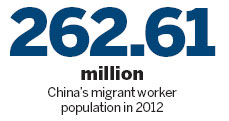
China had 262.61 million migrant workers in 2012, according to official data from the National Bureau of Statistics, but Dai Baozhen, vice-president of the school of management at Jiangsu University believes the real figure could be much higher.
The second generation of migrant workers is totally different from the first. People are heading to the cities not only to earn a living, but also to settle down and, unlike their parents, many choose to take their families with them.
"More farmers are now expected to pour into cities and towns to seek a new life after Premier Li Keqiang pledged that migrant workers would enjoy the same benefits as urban residents. However, there are many difficulties to overcome before that goal can be realized. One of them is the provision of effective medical insurance," said Dai.
Professor Liu Minghui attributed the differences between the treatment received by Zhao and Li to the nature of the urban-rural divide, which has resulted in a two-tier medical insurance system.
"Because of their special situation, migrant workers occupy a gray area between the Basic Medical Insurance System for Urban Employees and the NCMS," said Liu.
"The NCMS mainly provides health care for permanent rural residents but, in an ideal world, migrant workers would also be provided for under this system. However, although these people have spent a long time working and living in the cities and towns, if they want to benefit from the welfare system, they have to go back to the place where they have hukou. But that would be extremely expensive, of course, and if they have a serious illness, time is also a factor. Therefore, it's hard for them to gain any real benefits from the NCMS," he said.
Migrant workers are classified as urban residents when official statistics are collated, but compared with genuine urban residents, migrant workers rarely enjoy the same access to welfare, Liu said.


Copyright 1995 - . All rights reserved. The content (including but not limited to text, photo, multimedia information, etc) published in this site belongs to China Daily Information Co (CDIC). Without written authorization from CDIC, such content shall not be republished or used in any form. Note: Browsers with 1024*768 or higher resolution are suggested for this site.
License for publishing multimedia online 0108263 Registration Number: 130349