"Before the attack, I always thought I was in good health. I thought that joining the health insurance plan would be a waste of money. It wasn't until I benefited from it that I realized it was money well spent," he said.
Statistics from the National Health and Family Planning Commission show that between the first trials of the insurance program in 2003 and the end of June 2012, more than 812 million rural residents - around 95 percent of all rural residents - were listed under the system.
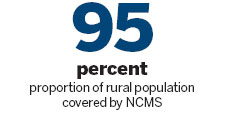
"A lot of people who've worked in the fields for a long time have chronic illnesses. Afraid of spending money, they would rather endure pain than visit the doctor. It's a vicious circle that can eventually lead to serious, or even fatal, illness. The increase in the level of reimbursement provided by the New Rural Cooperative Medical Care System, or NCMS, has greatly improved the health of rural residents and their standard of living," said Liu Minghui, vice-president of the school of public finance and taxation at Dongbei University of Finance and Economics, who has conducted research into medical insurance and urbanization for more than a decade.
|
 |
|
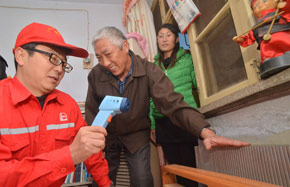
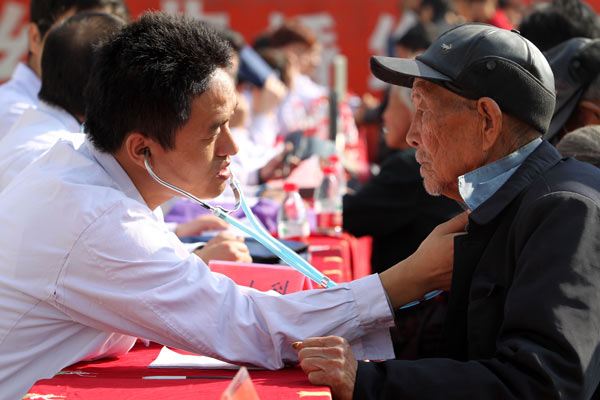
Medical experts provide checkups for residents of new rural communities in Xuchang county, Henan province, as one of the services organized by the local government to boost the urbanization process. NIU SHUPEI / FOR CHINA DAILY |
On the move
Hoping to earn a better living in the city, Li Zhiwei, another member of the Huangdi village medical insurance program, sold his house and moved his entire family to Beijing in 2002.
In the first few years, Li opened a small restaurant near a school in the capital's Changping district. Business was good, but the government demolished many of the buildings as part of a redevelopment plan. In addition, the rent began to soar so Li and his family had little option but to move further out to the northern suburbs. Failing to find a suitable room at a reasonable rent, they dropped the idea of reopening their restaurant and began doing odd jobs at nearby construction sites.
Because neither Li nor his wife had construction industry experience, their wages were quite low. After paying the rent and their daily expenses, plus providing funds for their student daughter, they were unable to put money aside in the form of savings.
In May last year, Li took a heavy fall down a set of stairs at a construction site, which resulted in a broken leg and two cracked ribs. His workmates sent him to a nearby hospital for treatment, but the 20,000 yuan medical fee meant he discharged himself just a week after undergoing surgery on his leg, even though the doctor urged him to stay.
Although Li had joined the health insurance program in his village, he didn't have a transfer agreement with the hospitals assigned by his health insurance. That meant he was unable to claim for reimbursement of his medical costs because he was treated at a hospital outside the district in which he held hukou, the Chinese system of home registration. To make matters worse, Li's boss didn't provide basic medical insurance for his employees, so Li was left to foot the bill himself.


Copyright 1995 - . All rights reserved. The content (including but not limited to text, photo, multimedia information, etc) published in this site belongs to China Daily Information Co (CDIC). Without written authorization from CDIC, such content shall not be republished or used in any form. Note: Browsers with 1024*768 or higher resolution are suggested for this site.
License for publishing multimedia online 0108263 Registration Number: 130349