|
 |
|
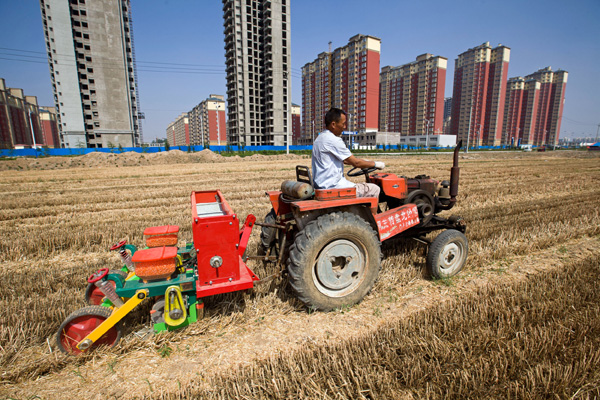
New buildings in Huaxian county, Henan province. Urbanization will play an active role in keeping the country's investment and growth stable. [Photo/China Daily] |
Growth of cities can address the nation's economic challenges, NDRC official says
A new wave of urbanization could spark the consumption and investment needed to address China's complex economic situation, the nation's top economic planner said on Wednesday.
Xu Shaoshi, chairman of the National Development and Reform Commission, told an internal webcast that this year will be crucial for promoting the country's urbanization process.
China's economy is in a critical period, with statistics in April-particularly investment growth-revealing continued pressure, said Xu.
New urbanization, together with other major driving forces such as key sectors for investment and consumption, and a drive by equipment producers to "go global", will play an active role in keeping investment and growth stable, he said.
This year, the government aims to move about 10 million agricultural workers and other rural residents into cities and towns and help 10 million migrant workers obtain hukou (urban household registration), which will make them genuine urban residents.
Millions of migrant workers live in cities where they do not have legal residence rights, which limits access to social services, education and even the right to own housing in some cases.
Urbanization will increase demand for developing municipal infrastructure and public services. For example, about 7.4 million affordable apartments need to be built this year and an additional 60 billion yuan ($9.67 billion) needs to be invested in urban renewal, said Xu. The nation's cities also need another 50 million parking lots.
Investment in telecommunications infrastructure has great potential as China's Internet speed ranks about 80th worldwide.
Nurturing small and medium-sized cities and promoting the integration of migrant workers into cities are priorities of the new urbanization.
The country has made progress in land reform and exploring a cost-sharing mechanism in pilot regions that will help migrant workers settle in cities and get access to social services, said Xu.
Sustainable financing systems must be put in place, said officials. For projects that can generate stable long-term revenue, public-private partnerships (contractual partnerships between public and private-sector organizations) can be a major way to attract investment.
An official of the Chongqing municipal government said the city signed 13 such projects in 2014 with a total investment of 130 billion yuan.
In March 2014, the State Council announced an urbanization plan running through 2020 that is intended to eliminate any obstacles to urbanization and expand rural residents' access to social services and education.
China aims for an urbanization rate of 60 percent by 2020. The figure was 54.8 percent as of the end of 2014, according to the National Bureau of Statistics.
In China, about 500 million people have moved to cities since 1978, the largest urbanization shift in history. It has been forecast that another 300 million people will move to the cities in the next 20 to 25 years, making China the first country to have 1 billion city dwellers.
Resettling these rural residents into city life could cost about 650 billion yuan a year, according to the Chinese Academy of Social Sciences, the leading central government think tank.

Copyright 1995 - . All rights reserved. The content (including but not limited to text, photo, multimedia information, etc) published in this site belongs to China Daily Information Co (CDIC). Without written authorization from CDIC, such content shall not be republished or used in any form. Note: Browsers with 1024*768 or higher resolution are suggested for this site.
License for publishing multimedia online 0108263 Registration Number: 130349