 |
|
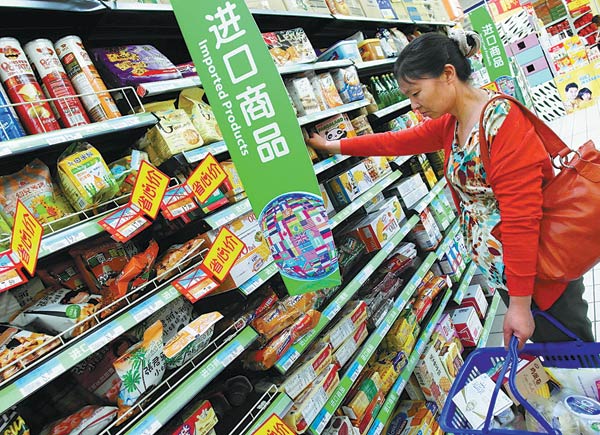
A customer selects imported biscuits, cookies and crackers at a supermarket in Yichang, Hubei province. As Chinese consumers now look for more choices in terms of health and convenience, food imports to China have grown rapidly in recent years.[Provided to China Daily] |
Nation's growing middle class shells out more for foreign agricultural products
China has long taken a cautious approach to controlling its staple grain import quota each year to ensure food security, but when it comes to other foodstuffs, overseas agricultural products are being warmly welcomed by the nation's fast growing middle class.
Thanks to the country's fatter wallets and increasingly diverse diet, China imported 320,000 metric tons of fresh milk and 283,000 tons of mutton in 2014, up 73.5 and 9.3 percent year-on-year, according to the General Administration of Customs.
The world's most populous nation also purchased 71.4 million tons of soybeans and 383 million liters of wine from overseas markets, up 12.7 and 1.6 percent, respectively, from a year earlier.
The value of its fruit imports reached $9.19 billion last year, rising 6.3 percent on a year-on-year basis.
Ding Lixin, a researcher at the Chinese Academy of Agricultural Sciences in Beijing, says even though the prices of mining resource-based commodities such as coal and iron ore are quite low at the moment in the global market, international wine producers, meat suppliers and dairy product providers have become the biggest beneficiaries of China's market boom for agricultural products.
"The stable growth of China's agricultural output and rising national incomes have provided diversified access to food with a higher protein content and better taste," says Ding.
"As a result, China has adequately raised the quantity of its grain imports, especially corn, soybeans, rapeseed meal and sorghum, over the past decade to support the growth of its livestock and aquatic feed industries."
Food consumption is normally a clear indicator of a nation's economic health and the size of its population. In China, meat consumption is rising, and people are eating a greater variety.
Staple foodstuffs such as meat, fish, eggs and milk have become more sophisticated, and consumers now look for more choices in terms of health and convenience.
As many people in China, in particular in urban areas, are increasingly aware that pork contains more fat and less protein than lamb, the country's pork consumption and import volume dropped 2 and 3.3 percent on a year-on-year basis in 2014.
Yu Bin, director of the department of macroeconomic research at the State Council Development Research Center, says although changes in food consumption reflect greater economic vitality, the country's ongoing urbanization and upwardly mobile population are other key factors that have shifted Chinese diets from being mostly grain-based to ones that include more meat and dairy products.

Copyright 1995 - . All rights reserved. The content (including but not limited to text, photo, multimedia information, etc) published in this site belongs to China Daily Information Co (CDIC). Without written authorization from CDIC, such content shall not be republished or used in any form. Note: Browsers with 1024*768 or higher resolution are suggested for this site.
License for publishing multimedia online 0108263 Registration Number: 130349