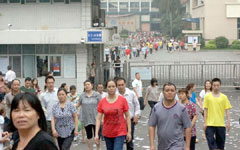
After local authorities intervened, most of the workers had returned to the assembly line by April 25, but not before the shoemaker reported a loss of $58 million.
Earlier this year, 1,000 workers at an IBM Corp factory in Shenzhen, Guangdong, demonstrated for higher pay when the factory was about to be handed over to Lenovo Group Ltd, a Chinese PC producer. Half of the workers reportedly walked out after IBM sacked 20 demonstrators.
Regarding the new labor regulation, Tsui of the manufacturers association said concern has spread among Hong Kong manufacturers that endless negotiations and sabotage may be their lot.
|
 |
|
 |
"The new regulation, if it takes effect, will hit our confidence hard in Guangdong," Tsui said. "It may be the last straw for the factories already dragged down by heavy debt burdens and spoil the appetite for further investment."
He added that "two-thirds of factories in Dongguan have left - either shut down or moved. The situation in Shenzhen is even worse. I'm afraid that when the new rules take off, more will be on their way."
Paying as much as 11,000 yuan ($1,770) a month to his engineers, Tsui said the continuous training of technicians and renewal of machinery are key to making value-added goods. "However, the more modernized our factories are, the fewer workers there will be. It is going to be easier for them to get together against management."
No matter how dubious manufacturers are about the new regulation, the aging population in China has become an inconvenient truth. The era of cheap and endless labor is reaching its end.
According to the National Bureau of Statistics, by the end of 2013, the working-age population - from 16 to 59 years old - was 919.54 million, or 67.6 percent of the population. That's 2.44 million less than at the end of 2012, or a decline of 0.27 percent year-on-year. The country started see its labor force wane in 2012, when the working population experienced a shrinkage of 3.45 million compared with 2011.

Copyright 1995 - . All rights reserved. The content (including but not limited to text, photo, multimedia information, etc) published in this site belongs to China Daily Information Co (CDIC). Without written authorization from CDIC, such content shall not be republished or used in any form. Note: Browsers with 1024*768 or higher resolution are suggested for this site.
License for publishing multimedia online 0108263 Registration Number: 20100000002731