 |
|
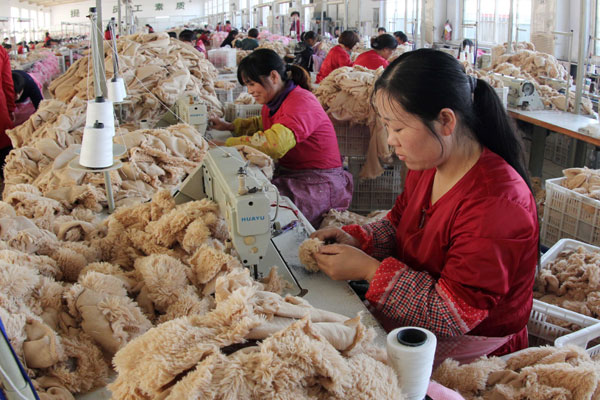
Workers produce stuffed toys at a factory in Ganyu county in Jiangsu province. Si Wei / For China Daily |
China's skill gap could derail its economic upgrade, Long Guoqiang, a member of a cabinet-level think tank, said.
Filling the gap is strategically important for China as it tries to leave behind its role as the "world's factory" and move up the global value chain, said Long, director-general of the general office of the Development Research Center of the State Council.
Long's comments came amid concerns that China is rapidly losing its comparative advantages - such as being a source of low-cost labor - that drove the nation to be the world's second-largest economy and biggest merchandise trader.
The advantages have faded. Long cited an international study that showed that 20 years ago, Thailand's average wage was 2.3 times that of China's. By 2012, the situation had reversed. Thailand's average wage was just 70 percent of China's.
|
 |
|
 |
China's problem, Long said, is deepening globalization. It's increasingly difficult for companies to switch output, as Japanese firms did 40 years ago, from labor-intensive industries such as clothing or toy-making, into capital-intensive, more value-added sectors such as chemicals or cars.
Different value chains in various industries have been established and are based on cross-country collaboration, Long said.
"A firm should focus on enhancing a specific international value chain, moving from manufacturing, usually with the lowest added-value, to research and development, or retail, marketing and branding," Long said. "And to support that task, China needs a qualified labor force."
The realities are grim. A survey by the National Bureau of Statistics showed that among the 269 million migrant workers in China - people who leave the village, town or city they are registered in to seek a job - only 32.7 percent have received training in the workplace.
A countrywide manufacturing competitiveness study by Deloitte Touche Tohmatsu Ltd showed that in the eyes of CEOs and senior leaders around the world, China ranked first in manufacturing competitiveness. The country lagged in labor productivity, only scoring 14.2, while the United States scored 68.2 and Germany 43.3.
Demand still outstrips supply for low-skilled labor, Long said. It leads people to frequently change jobs. They seldom have time to hone skills and have little incentive to accept employers' offers of vocational training, Long said.
The Education Ministry plans to convert half of its higher-education institutions, about 600, to vocational education schools.

Copyright 1995 - . All rights reserved. The content (including but not limited to text, photo, multimedia information, etc) published in this site belongs to China Daily Information Co (CDIC). Without written authorization from CDIC, such content shall not be republished or used in any form. Note: Browsers with 1024*768 or higher resolution are suggested for this site.
License for publishing multimedia online 0108263 Registration Number: 20100000002731