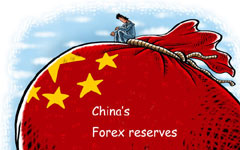
China's foreign exchange reserves, the largest in the world, reached a record $3.82 trillion last year.
Since China's reserves started accumulating more than a decade ago, the increase has been widely regarded as an encouraging and beneficial development. With China gradually becoming the "world's factory" and posting an increasing trade surplus in the past decade, Chinese reserves ballooned. During that period, the Chinese felt positive about growing reserves. But now they are feeling increasingly nervous about the situation.
|
 |
|
 |
The US government budget limit problem last October once again highlighted the possibility of a US default, which would not only affect its creditworthiness and the cost of US government financing but also the value of China's reserves and the confidence of the country, which is the largest investor in US government securities.
Not only would China lose due to the reduced value of its investment in US Treasury notes and related assets, but it also could be criticized for allowing the US government to maintain low interest rates and release unprecedented amounts of liquidity into the global economy.
As finance textbooks would preach in any investment context, to diversify is probably the most effective way to hedge against risks coming from a specific country or asset. Consequently, China should diversify its reserve assets.
China has been trying to diversify those assets during the past few years. According to US Treasury statistics, US dollar-denominated assets make up about 49 percent of Chinese reserves, down from 69 percent about three years ago.
China's foreign exchange reserve administrators have realized the risks associated with concentrated holdings in US dollar-denominated assets.
China has increased the proportion of Treasury bills in its US dollar-denominated assets, primarily due to its heightened risk of exposure in US government agency securities from the subprime mortgage crisis.

Copyright 1995 - . All rights reserved. The content (including but not limited to text, photo, multimedia information, etc) published in this site belongs to China Daily Information Co (CDIC). Without written authorization from CDIC, such content shall not be republished or used in any form. Note: Browsers with 1024*768 or higher resolution are suggested for this site.
License for publishing multimedia online 0108263 Registration Number: 20100000002731