Comments
  Print
Print  Mail
Mail  Large Medium Small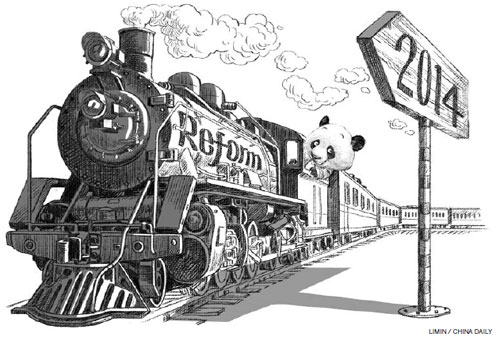
The Chinese government wrapped up its annual Central Economic Work Conference (CEWC) on Dec 13 and released a statement afterwards. The CEWC is part of the annual policy cycle, following on the Politburo meeting earlier this month.
The statement is meant to express the government's view on: first, current economic developments and the outlook for next year; second, the overall macroeconomic policy stance; and third, in general terms, giving an idea of the focus of economic policymaking and structural reforms next year.
The CEWC sets the stage for more concrete policy formulation in the coming months, in the run-up to the presentation of the work reports of the premier, the National Development and Reform Commission and the Ministry of Finance to the National People's Congress in March.
The statement suggests an emphasis on stability; stability of economic growth and macroeconomic policy, but also on policymaking more generally. While the statement suggests reforms in several areas in 2014, it does not indicate major movement next year on key, but thorny areas such as reform of the fiscal system, rural land arrangements and State-owned enterprise issues.
The statement discusses preventing "debt risk" but does not necessarily imply a major shift in the stance on overall credit growth. The emphasis is on local government debt; on improving supervision, regulation and budgeting; and the statement lays the responsibility for local debt in the hands of provincial and municipal governments.
While the statement calls for adjusting the economic structure and stimulating domestic demand, there is relatively little focus on rebalancing away from investment to consumption or on urbanization and its role in adjusting the pattern of growth.
While the growth target for 2014 was not mentioned, the statement emphasized the need for "stable", "reasonable" growth. Thus, it would not surprise us if the government ends up setting a target of 7.5 percent for GDP growth next year.
The official prescriptions remain for fiscal policy to be "proactive" and monetary policy "prudent". These labels should not really be taken literally but the fact that they remain unchanged matters and is consistent with a stability-oriented approach.
The line on stability of policy extends to policies with regard to the property market; there is no call for either relaxing or tightening them.
A "focus on debt risk prevention" is one of the six key tasks the government has set for 2014. Such an emphasis is not new; last year's statement after the CEWC did the same. Thus, it does not necessarily imply a major shift in the stance on overall credit growth. Indeed, the language on debt is matched by a commitment to maintain growth of money, credit and social financing at "a reasonable pace".
This year's statement emphasizes local government debt. It calls for better regulation, supervision and budgeting. It also lays the responsibility for controlling and resolving local government debt in the hands of provincial and municipal governments instead of the central government.
The statement mentions several areas of economic reform, without including a lot of specifics. These areas, and the language used to discuss them, are largely similar to that in earlier policy documents, for instance the statement after last year's CEWC. But there are changes.
There is more emphasis than before on the need to "resolve the overcapacity problem".
The statement suggests the government will continue to stimulate domestic demand. However, as in the March 2013 work report of the government to the National People's Congress, there is little emphasis on the need or plan to rebalance the pattern of growth towards more consumption and services, away from investment and industry. While the statement noted that consumption has a "basic role", it added that investment has a "key" role.
Copyright 1995 - . All rights reserved. The content (including but not limited to text, photo, multimedia information, etc) published in this site belongs to China Daily Information Co (CDIC). Without written authorization from CDIC, such content shall not be republished or used in any form. Note: Browsers with 1024*768 or higher resolution are suggested for this site.
License for publishing multimedia online Registration Number: 20100000002731