Tackling excess capacity will be one of the top tasks on China's economic agenda in 2014, as the issue becomes a major challenge to maintaining the pace and quality of economic growth.
|
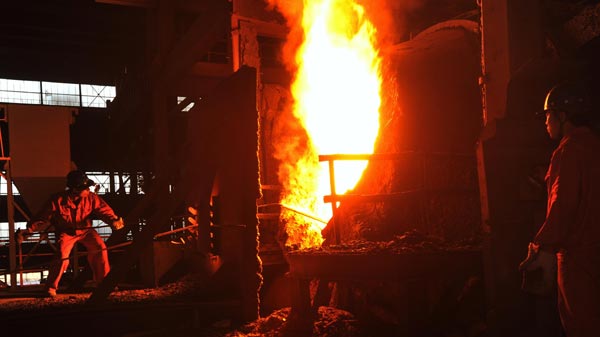 Workers at a steel plant in Dalian, Liaoning province. A statement from the Central Economic Work Conference said that the government will cut overcapacity in some sectors, including iron and steel. Liu Debin / For China Daily |
"The Chinese economy still faces downward pressure next year," the Central Economic Work Conference pointed out on Friday, citing the capacity issue weighing down some sectors as one of the major challenges facing the world's second-largest economy.
The key annual economic meeting, which sets the tune for the following year's economic policy, vowed to make strenuous efforts to adjust the country's industrial structure by eliminating obsolete and unneeded capacity and promoting innovation-driven growth.
"We will vigorously develop strategic emerging industries, speed up the development of service sectors and promote the optimization and upgrading of traditional industries.
"We will create an environment that will enable enterprises to become the main force in innovation," the CEWC meeting declared.
In the process, the government will strengthen the protection of intellectual property rights and improve tax policies to facilitate innovation.
Authorities also called for measures to guarantee new jobs for laid-off workers.
In the meantime, the National Development and Reform Commission, the country's top planning agency, revised an investment-approval catalog in a bid to avoid new production capacity in redundant sectors.
While granting more freedom to local authorities in approving investment projects in most sectors, a move meant to streamline the investment approval procedures, the NDRC retained approval rights over certain sectors with excess capacity, such as steel and aluminum. The central government will also retain approval power for coal-fired power plants and coal exploration.
Those rights won't be transferred to local governments until more detailed entry rules are clarified.
Meanwhile, new facilities for the production of steel, aluminum, cement, plate glass and ships are strictly prohibited, according to the NDRC.
Mao Zhenhua, director of the Economic Research Institute at Renmin University of China, said the effort to tackle excess capacity may not yield immediate results because of resistance from local governments. But eliminating unneeded capacity will benefit the relevant industries over the long term by lowering leverage in these sectors.
"Consolidation in the coal sector is nearly complete, although the effect won't be clear until downstream demand improves. But the steel sector will still see new capacity outstripping eliminated facilities over the next three years, and so will the aluminum sector.
"The cement sector is the only disciplined sector that does not see too much overcapacity," Mao said.
Stricter regulation of smaller manufacturing plants will reduce capacity in the cement market and benefit leading players, Fitch Ratings Inc said in a recent report.
Cement companies will benefit from an increase in average selling prices in 2014, supported by demand from infrastructure and property construction activities, Fitch said.

Copyright 1995 - . All rights reserved. The content (including but not limited to text, photo, multimedia information, etc) published in this site belongs to China Daily Information Co (CDIC). Without written authorization from CDIC, such content shall not be republished or used in any form. Note: Browsers with 1024*768 or higher resolution are suggested for this site.
License for publishing multimedia online 0108263 Registration Number: 20100000002731