

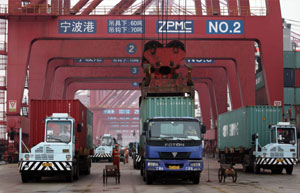
China, Russia and Kazakhstan are counting on a new ground transportation corridor stretching from eastern China's Jiangsu province to St. Petersburg in Russia to help stimulate regional trade and better connect their economies, according to industry experts.
 |
"Under the current global economic setting, enhancing regional connectivity will be in the interests of all member states of the Shanghai Cooperation Organization at this year's meeting in Tashkent, especially for these three nations," said Luo Renjian, a researcher at the Institute of Transportation Research under the National Development and Reform Commission in Beijing.
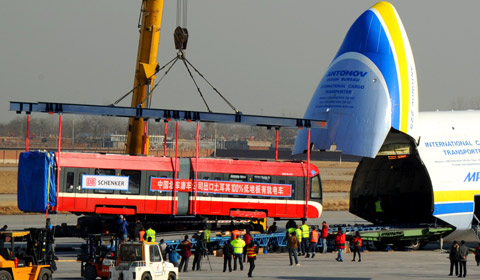
Transporting goods from China to Europe takes between 15 and 45 days, either through the Suez Canal or the Trans-Siberian Railway. Commodities are usually distributed in containers and first routed through international logistics centers such as Rotterdam, Hamburg or Frankfurt.
From these European transportation hubs, Chinese commodities travel a long distance before arriving at their final destinations in Russia or Kazakhstan. This arrangement puts added financial pressure on companies at each end of the route.
Luo said the new corridor will become Central Asia's most important freight artery. Transit times, he estimated, will be shortened by 10 to 14 days.
Freight volume passing through the Kazakhstan portion of the corridor is expected to increase from the current mark of 1 million tons to 3.5 million tons, according to an estimate from Kazakhstan's Transportation and Communication Ministry that was released in June.
"A road passing through the Khorgos border checkpoint on the Kazakh border with China to the Zhaisan border checkpoint with Russia is key for the economies of Kazakhstan and its neighboring countries," said Wu Hongwei, a researcher with the Institute of Russian, Eastern European and Central Asian studies under the Chinese Academy of Social Sciences.
The road, once finished, is also expected to attract foreign investment into Russia and Central Asia. Service sectors as a result will likely expand in the two regions.
"Building roads can be a tempting package to develop the service industry, logistics, hotels and infrastructure-related businesses. It will also create jobs for small and medium-sized enterprises and large joint ventures such as cement and steel plants in Kazakhstan," said Hou Hanping, a professor of logistics management at Beijing Jiaotong University.
"Other Central Asian countries such as Tajikistan and Uzbekistan will also establish trade companies close to the new corridor in Kazakhstan to expand their agricultural and precious metal exports to both European and Chinese markets."
About 2,450 km of the existing road in Kazakhstan, built during the Soviet era, will be rebuilt. Half of the new highway in Kazakhstan will have two lanes; the other half, which is near urban, populated areas, will have four.
Large Chinese construction machinery makers such as XCMG Construction Machinery, Zoomlion Heavy Industry Science and Technology and Sany Group have already made their push to increase production as Kazakhstan experiences a boom in infrastructure that began in 2009.
"From a long-term perspective, we are certain that many new towns will be built along the new Asia-Europe transport corridor," said Lu Chuan, vice-president of XCMG.
"After Astana became Kazakhstan's capital in 1997, the expansion of urban areas in that country has not ended. The country still plans to build more railways, underground lines, office buildings, service facilities and logistics warehouses."
XCMG will invest 3 billion yuan ($490 million) in the Xinjiang Uygur autonomous region to build a large manufacturing base to produce cranes, excavators and bulldozers that will be used in neighboring Central Asian markets in 2014.
|
|
|
|
|
|
|
|

Copyright 1995 - . All rights reserved. The content (including but not limited to text, photo, multimedia information, etc) published in this site belongs to China Daily Information Co (CDIC). Without written authorization from CDIC, such content shall not be republished or used in any form. Note: Browsers with 1024*768 or higher resolution are suggested for this site.
License for publishing multimedia online 0108263 Registration Number: 20100000002731 















 Op Rana
 Berlin Fang
 Zhu Yuan
 Huang Xiangyang
 Chen Weihua
 Liu Shinan