|
 |
|
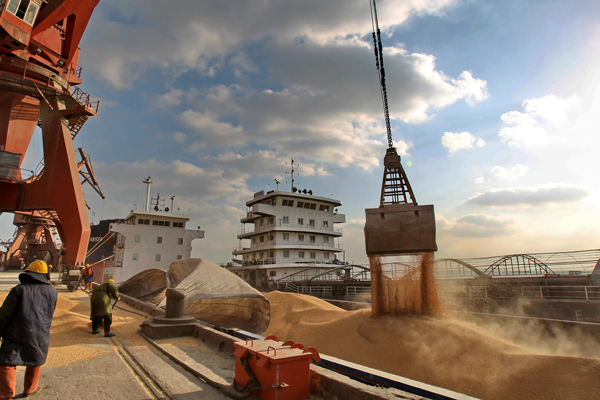
Imported soybeans are offloaded from a ship at a port in Nantong, Jiangsu province. Last year, soybean imports rose 11.2 percent year-on-year to 58.4 million metric tons, and imports are set to rise further in the 2013-14 market year. Xu Congjun / For China Daily |
Soybean imports are likely to rise to a new high in the 2013-14 market year (September 2013 to August 2014) following a drop in domestic output and greater demand for animal feed and edible oil.
Heilongjiang province in Northeast China, the nation's largest soybean producer, endured heavy rain and flooding over the past four months.
There are more than 235 million hectares of soybean farmland, which had an output of 4.64 million metric tons in 2012, according to Heilongjiang's agriculture commission.
"The adverse weather conditions have severely undercut Heilongjiang's soybean production this year and will force China to import more foreign soybeans to meet its domestic demand," said Hu Zengmin, an analyst at the China National Grain and Oils Information Center in Harbin.
"Based on rising market demand, China's soybean imports in 2013-14 are likely to rise by 15 percent from the previous market year," making 10 consecutive years of rising soybean imports, Hu said.
Soybean imports rose 11.2 percent to 58.4 million tons in 2012 from a year earlier, while prices were up 5.8 percent year-on-year to $599.30 per ton, according to the General Administration of Customs.
Hu said Heilongjiang's soybean production may drop by between 650,000 and 500,000 tons this year.
The grain and oils information center forecast that China's soybean output would fall by up to 2.6 percent to 12 million tons from a year ago, which would mark the third year running of declining output.
The US Department of Agriculture also forecast China's soybean imports to hit 69 million tons in the 2013-14 market year, a 16 percent increase over the previous year.
Zhang Xiaoping, director for China at the US Soybean Export Council, said that because the price of corn has remained high, many farmers in Heilongjiang switched from growing soybeans to corn, even though the latter crop costs more to cultivate.
Data show that the declining cultivation of soybeans in Heilongjiang has been because of higher corn prices as well as government guarantees of minimum purchase prices.
Farmers in Northeast China can get between 9,000 yuan ($1,470) and 12,000 yuan per hectare from corn, while soybeans earn them only 7,500 yuan per hectare.
China imported 17.7 million tons of soybeans from the US in September, an increase of about 18 percent over the same period last year.
"This is a positive sign for China to import more US soybeans at the beginning of the 2013-14 market year," Zhang said. "From a short-term perspective, Chinese companies will keep a close eye on the US market until April and May of next year, before the South American market starts its soybean selling season."
China purchased 21.5 million tons of soybeans from the US in the 2012-13 market year. Zhang expects it will import between 22 million and 24 million tons of US soybeans in the next market year.
China did not become a major international soybean market until the 1990s. Rising financial capability and the desire to improve the nation's diet by raising the consumption of pork, poultry, eggs and vegetable oil have pushed China to become the world's largest importer and consumer.
To further meet domestic demand, China National Cereals, Oils and Foodstuffs Corp, China Grain Reserves Corp and Chinatex Corp signed a number of deals with US grain traders Archer Daniels Midland Co, Bunge Ltd and Columbia Grain to import 4.83 million tons of their soybeans in late September. Those beans will ship to China between now and next March.
Zhang said South America's weather conditions and infrastructure, especially regarding Brazil's and Argentina's efforts to improve road and port facilities, will play a key role in determining the size of their soybean exports to China.
The soybean sector covers a range of businesses that involve food and oil processing, production, animal husbandry, chemical fiber and other industries.
"With difficulties concerning land, water resources and temperature conditions, it is hard for China to meet the growing demand for soybeans domestically. Under such circumstances, it must buy soybeans from large foreign sources," said Ding Lixin, a researcher at the Chinese Academy of Agricultural Sciences in Beijing.
|
|
|
|
|
|
|
|
Copyright 1995 - . All rights reserved. The content (including but not limited to text, photo, multimedia information, etc) published in this site belongs to China Daily Information Co (CDIC). Without written authorization from CDIC, such content shall not be republished or used in any form. Note: Browsers with 1024*768 or higher resolution are suggested for this site.
License for publishing multimedia online 0108263 Registration Number: 20100000002731 











 Op Rana
 Berlin Fang
 Zhu Yuan
 Huang Xiangyang
 Chen Weihua
 Liu Shinan