Energy use, environment, emission reduction unsatisfactory
China might be on a steady course toward realizing its gross domestic product growth target set for the 12th Five-Year Plan (2011-15), but when it comes to saving energy, another factor in economic growth, the government has cause for concern.
Peng Sen, deputy director of the Financial and Economic Affairs Committee under the National People's Congress, the country's legislature, disclosed at a recent forum that his committee is doing a midterm evaluation of the plan. Many problems were spotted in the areas of energy consumption, environment and emission reduction. In general, the result was not considered "satisfactory".
|
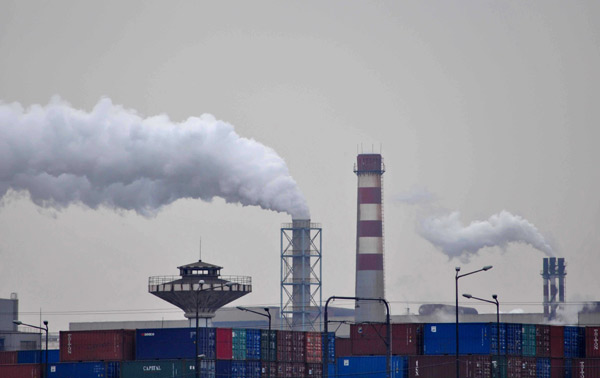 Smoke billows from a factory in Shanghai. China has made a commitment to the world to reduce energy consumption per unit of GDP by 16 percent by the end of 2015. [Photo / China Daily]
|
Another official from the National Development and Reform Commission, the nation's top economic planner and top energy policymaker, was quoted by National Business Daily as saying that the country's per GDP energy consumption has dropped by only 5.5 percent from its 2010 level.
China has made a commitment to the world to reduce energy consumption per unit of GDP by 16 percent by the end of 2015. This means that China in the first two years accomplished only 32.7 percent of the target, leaving a heavy task to accomplish the target in the next three years.
To meet the challenge, the commission has issued a special document to ensure a 3.84 percent annual cut in energy consumption per GDP unit and planned to ramp up financial support to facilitate upgrading and renewable energy development.
But the question is, has the financial subsidy really been effective in improving energy efficiency? After all, the commission had already poured billions of yuan into the cause. In 2012 alone, the central government granted 170 billion yuan ($27.4 billion) to local governments' endeavors, according to National Business Daily. But the result has not been satisfactory.
Cynics are quick to point out that there are many problems with the subsidy program. A considerable number of factories and power stations did not operate any energy-saving or emission-filtering facilities after buying them, just so they could gain the subsidy. But experts said even if the subsidy had been faithfully implemented, it may still be inefficient.
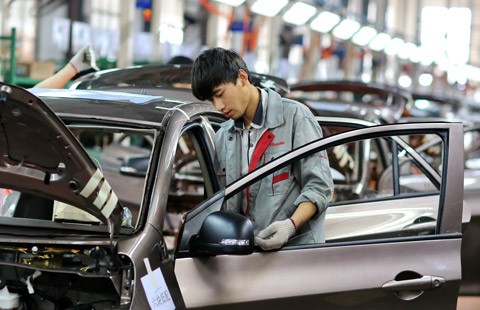
For one thing, the economy is still growing fast and is heavily dependent on manufacturing and investment, which usually use much more energy than services and general consumption. Although the economy only accounted for more than 10 percent of the world's economy, it used nearly half of the world's steel and more than half of its cement.
For another, the costs of most of the country's energy -namely water, electricity and gas- is government-controlled and fails to reflect the scarcity of the resources. While the price of some critical resources such as coal and metals are already market-based, the resource taxes imposed on them are still calculated on a volume basis, rather than being price-based.
"The pricing mechanism is the root of energy inefficiency. The central government has already realized this and will fix the mechanism in the upcoming Third Plenary Session of the 18th Communist Party of China Central Committee," said Chai Fahe, vice-president of the Chinese Research Academy of Environmental Sciences.


Copyright 1995 - . All rights reserved. The content (including but not limited to text, photo, multimedia information, etc) published in this site belongs to China Daily Information Co (CDIC). Without written authorization from CDIC, such content shall not be republished or used in any form. Note: Browsers with 1024*768 or higher resolution are suggested for this site.
License for publishing multimedia online 0108263 Registration Number: 130349