|
|
|
 |
|
|
|||||||||
|
 |
Inflation rate hits 3.6% in March as further easing policies under review
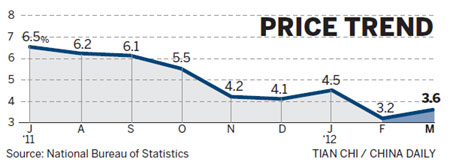
Inflation, driven by food and energy prices, hit a higher-than-expected 3.6 percent in March renewing concerns about inflationary pressures in the coming months.
The latest figure may see the government adopt a more cautious stance on monetary loosening and stimulus measures despite cooling economic growth, analysts said. The government's inflation target for the year is 4 percent.
The year-on-year consumer price index, a key inflation indicator, edged up last month by 0.4 percentage points more than in February, according to data released by the National Bureau of Statistics on Monday.
Food prices helped drive inflation as they account for about one-third of the weighting in the CPI calculation. They increased 7.5 percent last month from a year earlier. In February they increased 6.2 percent year-on-year.
Vegetable prices surged by 20.5 percent year-on-year, 14 percentage points higher than February's figure, according to the NBS.
Statistics from the Ministry of Commerce suggested that wholesale prices of 18 major vegetables rose for four consecutive weeks from February, posting an increase of 9.7 percent by early March.
Inflation hit a high of 6.5 percent in July, but has gradually fallen since then and another key gauge also released on Monday, measuring producer prices, fell. This could herald an easing of inflationary pressure, analysts said.
"Increasing labor costs as well as rising wages among traditionally low-income groups in cities have boosted the consumption of basic foods which might see price increases in other daily necessities," said Li Xunlei, chief economist with Haitong Securities Co Ltd in Shanghai.
Weather was also a factor in vegetable prices as drought and lower temperatures reduced crop yields, analysts said.
Rising oil prices played a key role and both weather and energy costs could come into play again in the second quarter, according to experts.
This may prompt the government to delay easing monetary policy, Li Huiyong, an analyst with Shenyin & Wanguo Securities, said.
The government raised fuel prices last month by its biggest margin in three years.
Premier Wen Jiabao said during a visit to eastern and southern China last week that the government will take measures to prevent a rebound in consumer prices.
Zhou Youqing, a sales director with bicycle manufacturer Shanghai Phoenix Import and Export, said that rising labor costs are more of a concern than the cost of materials.
"We expect the cost of raw materials to fluctuate but labor costs seem to be increasing all the time. If they keep going up we could be in trouble," he said.
Despite the rise in inflation, the producer price index, an indicator of future consumer prices, dropped 0.3 percent from a year earlier. It was the first decline since November 2009, showing a slowdown in manufacturing.
"The most alarming data was the PPI," said Yi Peng, a researcher with the cities and small towns development and reform center of the National Development and Reform Commission.
The decline was in line with the current slowdown in industrial output and falling company profits.
"The PPI figure indicates an increasing risk of an economic hard-landing," Yi said.
GDP may have slowed to 8.2 percent in the first quarter, against 8.9 percent for the last quarter of 2011, according to a Bank of China report.
"This may push the government to slightly ease monetary policy and support a steady economic expansion," the report said. It forecast that the second quarter's GDP is expected to rebound to 8.4 percent with policy stimulations.
The NBS plans to release the first quarter GDP figure on Friday.
A research note from JPMorgan Chase predicted that inflation might fall in the coming months, leaving more space for easing monetary policy.
"The government may cut the required reserve ratio for banks as early as this month," the note said.
The central bank raised the reserve ratio 12 times, to a record high of 21.5 percent, between January 2010 and December 2011. It also hiked interest rates five times since October 2010.
The government cut the reserve requirement ratio in November and February to boost leading.
Contact the writers at chenjia1@chinadaily.com.cn and gaochangxin@chinadaily.com.cn