|
|
|
 |
|
|
|||||||||
|
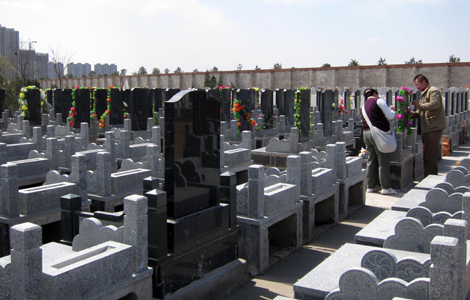
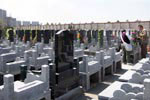
Residents from Beijing visit a graveyard in neighboring Hebei province on March 30. Because of the surging price of funeral plots in Beijing, many Beijing residents have begun to buy them in neighboring provinces.?[Photo / Xinhua] |
Residents seek graveyards in nearby provinces
Deep-rooted traditional beliefs and lack of regulations lie behind the surging prices of burial plots in Beijing, experts said.
The increase is forcing some residents to buy graveyards in neighboring provinces.
"Most people in China still prefer larger graveyards, which have become a rare commodity in crowded cities such as Beijing," Bao Yuan, director of the Huanqiu Funeral Institute, said on Wednesday.
"This has caused a surge in prices of funeral plots in big cities."
Some Beijing residents have complained that they cannot "afford to die in Beijing".
The cheapest plot in Tonghui Cemetery in the suburban Tongzhou district of Beijing costs 32,800 yuan ($5,200) and is less than three-quarters of a square meter, a sales woman told China Daily.
However, a square-meter plot in Gaojingyuan Cemetery in Baoding, a city neighboring Beijing, is no more than 10,000 yuan, according to Feng Yi, a manager of the cemetery.
"In recent years I have seen more people from Beijing buy plots in our cemetery, but most of them are those who have roots in Baoding," said Feng.
Bao said irrational consumption and vanity are playing a major role behind the surging price of funeral plots in big cities in China.
"It is no wonder at all that the prices of cemetery plots are so high in Beijing," said Bao. "Other commodities such as housing are also expensive in Beijing, due to limited resources and high demand."
Beijing Times quoted Jiang Xiaogang, vice-president of the Beijing Funeral Association, as saying that it is untrue Beijing residents cannot afford to die in the capital.
"It is true most people cannot afford a luxurious funeral in Beijing, but there are some cheap services provided by the government," he was quoted as saying.
Jiang said the Beijing municipal government provides inexpensive funeral services, including cheap ash boxes and free sea burial, but they have not been popular with residents.
Sales of cemetery plots is only a small part of the whole highly profitable chain in the funeral industry - including makeup and funeral paraphernalia such as urns and wreaths - that starts the moment a person is declared dead, Bao said.
"A lack of laws and regulations in the funeral industry is the main reason why it keeps reaping heavy profits," said Bao.
According to reports, a standard wooden urn for holding ashes, which costs less than 100 yuan, can be sold for thousands by funeral homes.
"Systemic problems also lead to unfair high prices," Bao said. "Funeral houses are managed by the government in China and are not supposed to gain profit. However, in reality they receive little State funding, which forces them to raise prices to cover their costs.
"People should also change their mindset and get rid of vanity when having a funeral," said Bao. "There are other means of burial, like sea burial, and burying the urn under a tree. It's not necessary to only seek a large grave."
Many people, however, find it hard to do so.
"I think it is right to advocate other ways of burial as land has become more scarce. But for me I can't accept a sea burial for my relatives," said a Beijing resident named Dong. "After all, Chinese people traditionally believe a deceased person cannot get peace until he is buried underground."
The key to check the disorderly development of the funeral industry, including excessively high graveyard prices, is to establish laws to regulate the industry, Bao said, though admitting there is not a great possibility of establishing such a law in the near future.
"Some experts are still expressing doubts about the necessity of using cremation as the basic way of body disposal, arguing Chinese people traditionally bury the deceased," he said.
"This is the reason why a national law on funeral management has not come into being yet."
wangxiaodong@chinadaily.com.cn