Chinese grab luxury goods
Updated: 2011-12-24 08:01
By Cecily Liu, Zhang Haizhou and yu ran (China Daily)
|
|||||||||||


|
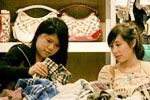
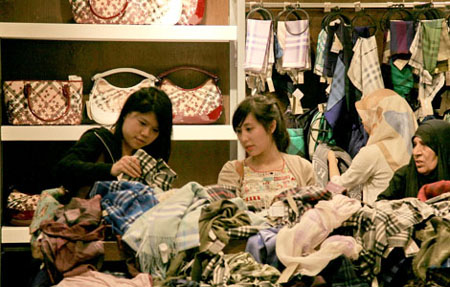
Chinese tourists shop at Bicester Village, a popular shopping area in London. Chinese tourists have taken a place among the top shoppers for luxury products in the world. [Photo/China Daily] |
And they are buying more tax-free goods than shoppers from any other country, China Daily learned from Global Blue, the largest tax-refund and shopping services provider in the world.
In the financial year ending in November, Chinese shoppers spent $2.15 trillion on tax-free products, a 56 percent increase from the same period a year before, according to Global Blue.
"This is a dramatic increase, driven by China's growing prosperity and its appreciating currency," said Manelik Sfez, vice-president of global marketing at the Switzerland-based company.
Global Blue said Chinese shoppers took part in 21 percent of the tax-free sales made so far in the world this year. In that regard, that put them ahead of Russian shoppers, who accounted for 15 percent of such sales, and of Japanese, US, and Indonesian shoppers, who each accounted for 4 percent.
Meanwhile, the value of November retail sales in Britain increased only by 0.7 percent above what it had been in the same month a year ago. In November 2010, the comparable increase was 2.8 percent and it was 4.1 percent in November 2009, according to statistics from the British Retail Consortium.
Stephen Robertson, director-general of the British Retail Consortium, said the pessimistic figures are "worrying", especially with "Christmas being so near".
Helen Dickinson, head of retail at the accountancy firm KPMG, said the retailing business in Britain is becoming weaker.
"Christmas is a crucial trading period for the UK retail sector but this year many retailers will be nervous and unsure as to how the season will pan out," Dickinson said.
Even so, Chinese shoppers helped to raise the December post-tax annual profits at the London department store Harvey Nichols by 32 percent above what they had been a year before, the company said.
Its neighboring department store, Harrods, meanwhile brought in more than 1 billion ($1.6 billion) in sales in 2011. Its pre-tax profits rose by 39 percent to hit 108 million.
To accommodate Chinese shoppers, Selfridges, a luxury department store in London's Oxford Circus, began accepting payments from China UnionPay cards this past year.
Britain's smaller cities are also experiencing an influx of Chinese shoppers. To take advantage of that trend, Manchester's Selfridges stores began giving their staff Mandarin lessons in October.
The work is paying off. Chinese customers are coming much more frequently to the stores - their numbers have increased by 62 percent this year - and are spending 1,000 on average in a single trip. The average for other customers is 70.
Recognizing the purchasing power of the Chinese, Angela Ahrendts, CEO of the fashion brand Burberry, has come to speak of the "Travelling Luxury Consumer".
Such customers are among the most important for the company.
"When Chinese consumers travel, they spend six times more than when they stay at home," Ahrendts was quoted as saying by the Financial Times. "Saying 'I bought this in London' adds further cachet."
Sfez agreed. "It is much more romantic and powerful to buy products of a luxury brand from its country of origin," he said. "That explains why duty free shops in airports don't perform as well."
"I prefer shopping for luxurious products in European cities like London, Paris and Milan - mostly for bags, watches and shoes, which are much cheaper and come with more options than you can find with the same items in China," said Shen Jie, who lives in Wenzhou, a city in Zhejiang province.
Shen said she usually spends about 300,000 yuan ($47,000) on luxurious items each time she goes shopping abroad.
And European retailers have good reason to think they will see more shoppers like Shen, since Chinese shoppers are going to that region in larger and larger droves. The British Tourist Authority VisitBritain predicts that, in 2014, the number of Chinese tourists coming to Britain will be 117 percent higher than it was in 2008.
Even so, Global Blue said Paris remains the most popular Christmas destination for Chinese travelers. It is the site of 15 percent of the luxury purchases Chinese shoppers make abroad; following it are London, the site of 10 percent of such purchases, and Milan and Berlin, each the site of 2 percent.
Some observers say that Chinese shoppers in recent years have become increasingly attracted to products with Chinese roots.
Still, Sfez said his team's data show these brands draw only a small percentage of luxury purchases.
"Luxury comes from history and continuity," Sfez said. "So Chinese luxury labels still have a long way to go."
Related Stories
Wealthy Chinese falling in love with luxury 2011-04-19 10:58
The wealthy spend more for luxury 2011-07-26 09:40
Luxury brands eye record numbers 2011-12-12 09:27
Updated tariffs on luxury products discussed 2011-10-14 09:21
Shortage drives up luxury car surcharges 2010-12-02 16:44
- China, Pakistan ink currency swap deal
- Furniture retailer fined after 'fake imports' scandal
- China's publishing companies urged to go global
- China imposes penalty for price violations
- Car dealers forced to find new strategies
- New Internet protocol to undergo test
- CBRC investigates Bohai loans case
- Drive underway for transparent data