Car dealers forced to find new strategies
Updated: 2011-12-24 08:01
By Li Fangfang (China Daily)
|
|||||||||||


|
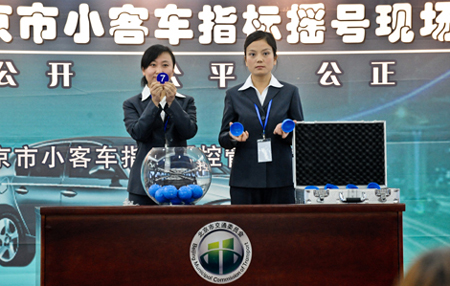
A lottery drawing for car license plates in March in Beijing. The odds against winning the right to register a vehicle in that drawing were 23 to 1.?[Photo/Xinhua] |
BEIJING - Despite the benefits Beijing's license plate quotas may have had on the city's troubled traffic situation, it stunted local car sales and forced automobile dealers to change their business strategies.
According to Su Hui, an official with the China Automobile Dealers Association, whole year sales of new vehicles are expected to plummet from last year's 890,000 units to 400,000 for 2011.
Beijing adopted a policy a year ago to cut down city traffic by limiting the amount of new license plates. Since January, new license plates are issued through a lottery system.
"Hampered by the lucky-draw policy, Beijing sold 355,000 vehicles in the first 11 months, a sharp, 53 percent decline from a year earlier. And the downturn will get worse in December," said Su. "Even the still-booming luxury car segment slowed year-on-year from 80 percent before August to about 40 percent now."
"The restriction has been the key killer of Beijing's automobile market in 2011," he said.
Though the frigid market put some Beijing automobile dealers in hot water, some even closing their businesses, Luo Lei, also of the China Automobile Dealers Association, said that the strict measure also helped local dealers to restructure their businesses and adjust the strategy.
"Chinese dealers have been conditioned to rely on new-car sales in the past five years because of the prosperous market performance," said Luo, deputy secretary-general of the association. "But in Western countries, only 20 percent of dealers' profit comes from new-car sales, while another 20 percent is from spare parts and 60 percent from after-sales service."
Luo said the shrinking market has forced local dealers to transform their businesses into mature, healthy and sustainable structures. "To survive, they have to improve their service and customer satisfaction, and expand their business reach into the secondhand car sector ."
According to Sinotrust, a consulting firm in Beijing, 70 percent to 80 percent of the new cars sold were bought by customers who traded in old vehicles. The car trade-in has been a major trend in Beijing's vehicle market this year.
"Local dealers will have a long road to recovery," Luo said. "And an official national policy and system for secondhand vehicles is urgently needed for the emerging segment."
In the first 11 months of the year, 344,000 secondhand vehicles were sold in Beijing, a 22.5 percent decline - thus, less severe than in new-car sales.
"The time is ripe for the secondhand car sector to take off,' Luo said.
Yan Jinghui, vice-general manager of Beijing Yayuncun Automobile Trade Market, said, "Because of the limitations placed on getting a license plate, local dealers have to sell more of their secondhand cars outside Beijing," Yan said. "Before the lottery policy, only 10 percent of secondhand cars in Beijing were bought by people outside the city. Now, the figure has surged to 60 percent."