Moller-Maersk staying afloat
Updated: 2011-12-22 09:36
By Zhou Siyu (China Daily)
|
|||||||||||


|
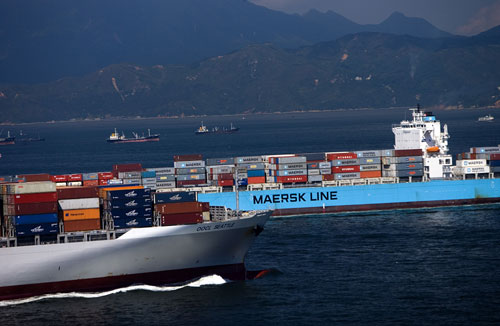 An AP Moller-Maersk Group container ship passes another ship as it leaves Hong Kong. [Photo/Bloomberg] |
World's largest container-ship operator battles stormy waters
COPENHAGEN - Standing handsomely on the waterfront of Esplanaden Boulevard in Copenhagen, AP Moller-Maersk Group's headquarters resembles a giant grey container with numerous windows.
Commanding 14.5 percent of the world's shipping capacity, the 108-year-old shipping conglomerate has been the world's largest container-ship operator for 15 years.
On top of the building flutters the company's flag, a white seven-pointed star against a light blue background, which has almost become a symbol of Danish economic prowess.
A gust of chilly wind rippled the water in front of the gigantic cube, sending the white star flag flapping, as if announcing the arrival of winter.
"For the shipping industry, we foresee the coming months and years will be volatile and difficult," said Nils S. Andersen, partner and group chief executive officer.
The biting cold has already stricken the whole industry. Pressed by surging oil prices and over-capacity, this year has seen deficits in most big shipping companies across the world.
During the first nine months of this year, Hanjin Shipping Co Ltd, Hyundai Merchant Marine Co Ltd and STX Pan Ocean Co Ltd, the three biggest shipping companies in South Korea, each reported losses of several hundred million dollars.
In China, COSCO Holdings Co, the country's largest shipping line by capacity, reported a 2.1 billion yuan ($330 million) loss for the third quarter.
During the first nine months of this year, revenue for AP Moller-Maersk Group increased by 9 percent year-on-year to $45 billion. But its profits declined by 26 percent from last year to $3.1 billion, according to the company.
Maersk's container business for the third quarter registered a loss of $293 million compared with last year's profit of $1 billion. Affected by the low freight rates (particularly on the Asia-Europe line), Maersk predicts a full-year loss for the container businesses.
"The shipping industry as a whole made a mistake by ordering too many vessels," Andersen said. "We should also be realistic about the situation: The market is growing more slowly than before, and business returns are low. We expect a result lower than that of 2010."
To the 53-year-old businessman, a declining shipping market is by no means a new test. He has faced situations far worse.
Hands on the helm
Dressed in a simple business style, Andersen combines a gentle smile with a steady, tough hand. Fluent in six European languages, he can talk about business for hours with short words, as if he is striving for simplicity in every sentence.
Andersen also has a good memory for figures. He can rattle off exact figures for any business division under the group. "Perhaps he knows more about figures than anyone in the company. It is very rare for a group CEO to be like this," said a company staff member close to him.
An economist by training, Andersen obtained his degree from the University of Aarhus in western Denmark. In the 1980s, he took a series of jobs at Carlsberg Group, the world's fourth-largest beer producer by market share, and became the chief executive officer in 2001.
He stayed in the top job for six years during which time his operational skills were fully tested by continued business expansion. He bought back shares from Orkla group, the Norwegian food and beverage company, clearing up the company's messy ownership structure.
He also accomplished a successful 1 billion euro ($1.38 billion) acquisition of Holsten-Brauerei AG, a German brewer, while continuously pushing for a takeover of Scottish & Newcastle PLC, a major British brewer. The bid was finally accomplished in April 2008, shortly after he left for Maersk.
Andersen joined Maersk at the end of 2007 and his first three years turned out to be a tough start. Affected by the global financial crisis in 2008, Maersk reported a $1 billion loss for 2009, the company's only loss since World War II. The container business alone suffered a loss of $2.1 billion, thanks to depressed freight rates.
"At the beginning of the financial crisis, we were not market-focused enough and not very cost-competitive. We learnt that through the crisis and we are getting better," Andersen said. "It is my firm belief that you should always work hard to make a simpler organization, which will enable you to react fast to the customers and the market. This applies to both the consumer-goods industry and the shipping industry."
But for a business group as big as Maersk, simplicity is not easy to accomplish. As early as 2008, the group started a series of cost reductions in the container business. In 2009, pressed by the difficult global economic climate, the group managed to cut its costs by $2 billion, with $1.6 billion in reductions coming from the container-shipping business.