Yet, given their relatively high correlation with US T-bills in the grand scheme of things, such diversification within US assets may not offer China a big enough hedge against fluctuations in US economic growth, the budget dilemma or a possible default.
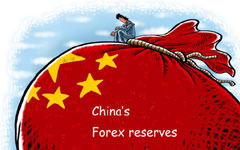
This situation is closely tied to the crux of the problem surrounding China's reserves: The country intends to diversify its reserves into other sovereign treasuries or assets, but it can find few alternatives.
|
 |
|
 |
Ignoring the economic situation of these regions for a moment, one would find the markets for such securities are small compared with those for US T-bills and agency securities.
Given the massive size of China's reserves, withdrawing from such a market would have profound effects and would inevitably damage the value of China's reserves.
One very important function of reserves is to serve as "ballast assets" that can be used to stabilize the value of a country's currency.
As a result, liquidity, immediacy and stability are crucial to reserve investments, and in this regard, US Treasury bills serve as a near-perfect choice.
However, many experts, including some Chinese central bank officials, believe that China's reserves are too large and a big chunk of them could be invested not for stability but for higher returns. If this is true, the real question becomes what the optimal size of China's reserves should be.
Although China has been trying hard to diversify into non-US-denominated assets over the past few years, the ballooning size of its reserves increases rather than decreases China's exposure to risk, and that seems to be the cause of Chinese anxiety over US fiscal problems.
If this is the problem, China should deepen its financial reforms, letting market forces determine its domestic interest rates and international exchange rate. Once China stops its passive "sterilization" of the inflows of dollars into its reserves, China's reserve investment challenges - along with many other challenges, such as domestic inflation and high housing prices - may be resolved once and for all.
The author is deputy director of the Shanghai Advanced Institute of Finance, Shanghai Jiaotong University.

Copyright 1995 - . All rights reserved. The content (including but not limited to text, photo, multimedia information, etc) published in this site belongs to China Daily Information Co (CDIC). Without written authorization from CDIC, such content shall not be republished or used in any form. Note: Browsers with 1024*768 or higher resolution are suggested for this site.
License for publishing multimedia online 0108263 Registration Number: 20100000002731