Comments
  Print
Print  Mail
Mail  Large Medium Small
|
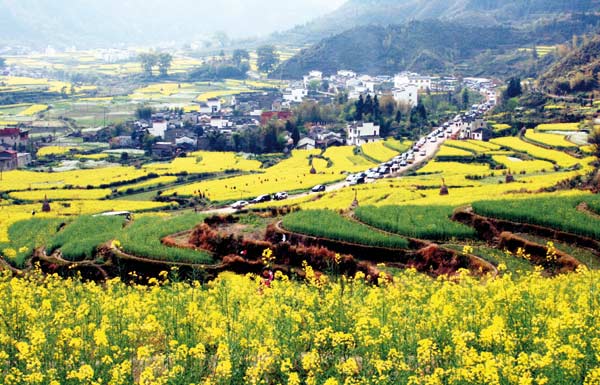 The blossoming of rapeseed flowers is one of the greatest tourist attractions in Wuyuan. [Photo / Provided to China Daily]
|
A spectacular bright yellow blanket of rapeseed flowers stretches to the horizon in spring; clear creeks offer water activities in summer; the mountains are cloaked in red leaves in autumn and folk custom events are all the go in winter.
It may seem that Wuyuan, a county in the northeastern corner of East China's Jiangxi province, has a lot to offer for tourists, while it is diversifying and investing more money in attracting international visitors and keeping them longer.
"When people think about Wuyuan, most think of rapeseed flowers, so every spring tens of thousands of visitors swarm into the villages for them," says Ge Jian, director of the Wuyuan County Tourism Commission. "But Wuyuan has much more than that. It has manors, canyons, ancient villages and the Huizhou culture. It is also different depending on the season when you come."
Wuyuan was established in the Tang Dynasty (AD 618-907) and is one of the cradles of Huizhou culture, which was nurtured by trade and bears the hallmarks of its many different clans and Confucianism.
However, because of the county's remoteness and poor transport, it was virtually unknown to outsiders just 14 years ago. There was no airport and no railway, so the only way to get there was by road and, for many, that meant taking a bus.
"Many people even called it Maoyuan because they did not recognize the character wu," Ge says, referring to the unusual character for the initial syllable in the name. "A few photographers passing through were enchanted by its beauty and stayed for a while."
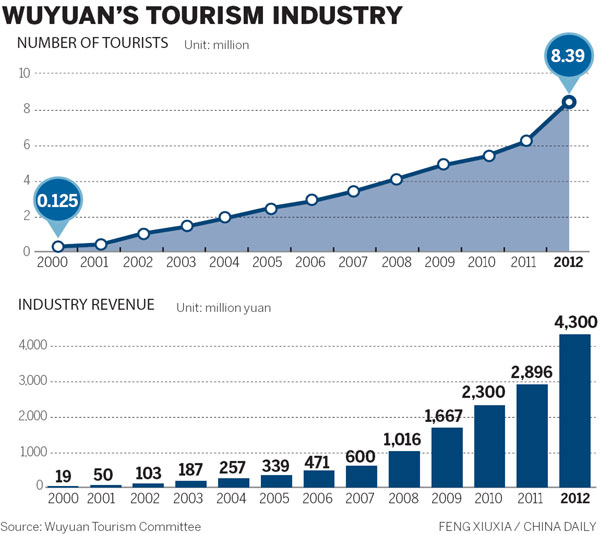
Little more than a decade after it began to open up it has become a role model for China's rural tourism. It was recognized as the country's first rural tourism experimental area in 2011. Last year 8.4 million tourists visited the county, 36 percent more than in 2011, and revenue from the industry was 4.3 billion yuan ($706 million), 48 percent more than in the previous year. More than 16,000 villagers who used to work in cities are now able to work closer to home, in the tourism industry.
One of the most surprising things about all of this is that behind it all is a photo. In the early 1990s, Chen Fuli, a photographer from Hong Kong, went to Jiangling village in Wuyuan to do a photographic project. A photo he took of rapeseed flower blossoms looking like a gigantic, luxurious brocade cascading from hilltop to valley won an international award in 1999.
Referring to Jiangling, Chen used the expression "China's most beautiful village", a catchphrase that has stuck. After his rapeseed photo drew widespread attention to Wuyuan, the flowers became a symbol of the county.
In 2001, former president Jiang Zemin, whose ancestors lived in the village, visited, putting it in the public spotlight again. From 2001 to 2003 the annual number of those visiting Wuyuan rose to 1 million from 247,200.
Copyright 1995 - . All rights reserved. The content (including but not limited to text, photo, multimedia information, etc) published in this site belongs to China Daily Information Co (CDIC). Without written authorization from CDIC, such content shall not be republished or used in any form. Note: Browsers with 1024*768 or higher resolution are suggested for this site.
License for publishing multimedia online 0108263 Registration Number: 20100000002731