Comments
  Print
Print  Mail
Mail  Large Medium Small
Whether genetically modified foods can help eradicate food insecurity and poverty has been the subject of contentious and polarizing debate.
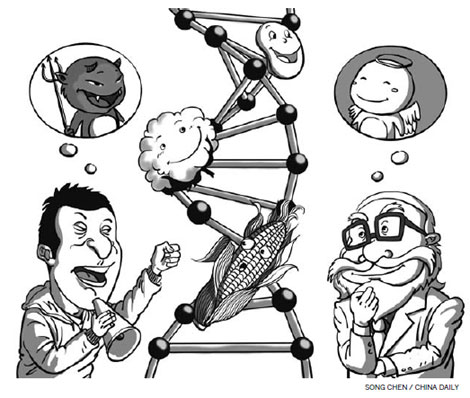
The backdrop to this debate is a global agricultural system that is facing increasing challenges from rising climatic variability, population growth, urbanization, and natural resource depletion. According to the Food and Agriculture Organization, food production needs to increase by 60 percent by 2050 in order to feed 9 billion plus people. Scientists and policymakers alike are searching for innovative ways to ensure sufficient access to nutritious food, today and for generations to come. Unlike previous science-based initiatives to raise productivity in the agricultural sector (such as the Green Revolution), the potential of GM crops to combat food security and poverty challenges is muddled in hotly contested discussions.
The considerable expansion of GM crop varieties worldwide over the last two decades is indisputable. The total area devoted to GM crops has increased 100-fold from 1.7 million hectares in 1996 to 170 million hectares in 2012. Developing countries now grow more GM crops than developed countries (in terms of area), largely driven by Brazil's recent fast-paced adoption of GM crops. China is home to approximately 4 percent of the total global area devoted to GM crops. Soybeans, maize, cotton, and canola dominate GM crops globally, whereas China's focus is on cotton, papaya, and poplar.
To date, a wide body of (peer-reviewed) scientific impact studies shows that commercially-available GM crops are safe for people and the environment. According to a 2010 review of the safety of GM crops by the European Union, "the main conclusion to be drawn from the efforts of more than 130 research projects, covering a period of more than 25 years of research, and involving more than 500 independent research groups, is that biotechnology, and in particular GMOs, are not per se more risky than, for example, conventional plant breeding technologies." Other international and national scientific bodies, such as the World Health Organization, have reached the same conclusion.
The documented impacts of GM crops point to many productivity, environmental, and socio-economic benefits among large- and small-scale farmers alike. Genetic engineering can boost yields by developing plant varieties that have increased resistance to stresses such as disease, pests, and droughts, lower fertilizer and water application, and higher nutritional quality.
 World's first 1-liter car debuts in Beijing
 Paper-made furniture lights up art show
 Robots kick off football match in Hefei
 Aerobatic team prepare for Aviation Convention
 China Suzhou Electronic Manufacturer Exposition kicks off
 'Squid beauty' and her profitable BBQ store
 A day in the life of a car model
 Vintage cars gather in downtown Beijing
Copyright 1995 - . All rights reserved. The content (including but not limited to text, photo, multimedia information, etc) published in this site belongs to China Daily Information Co (CDIC). Without written authorization from CDIC, such content shall not be republished or used in any form. Note: Browsers with 1024*768 or higher resolution are suggested for this site.
License for publishing multimedia online Registration Number: 20100000002731