Rural residents reap rewards as migrant workers send back cash
Although China's future economic outlook is still uncertain amid global recession, a huge amount of purchasing power will be unleashed through urbanization, a recent report said.
Urbanization is a process in which the rural population moves into cities and towns. Over the past 20 years, China experienced an ever-accelerating process of urbanization. According to the National Bureau of Statistics, China's urban population reached 690 million in 2011 from 170 million in 1978. The percentage of the urban population increased from 17.9 percent in 1978 to 51.3 percent in 2011, while the rural population plunged from 82.1 percent in 1978 to 48.7 percent in 2011.
|
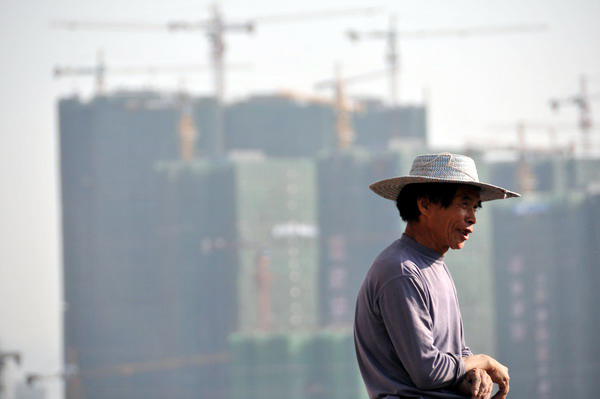 A migrant worker taking a break at a building construction site in Chongqing in Southwest China. More than 20 million rural people have become urban residents annually over the past decade, according to the National Bureau of Statistics. These new urban residents have become a new force driving up the nation's growth in consumption. [Photo / China Daily] |
The rapid urbanization has seen a large number of rural workers become urban residents. The trend will continue to maintain upward momentum in the immediate future. It will bring a sharp increase in consumer demand and investment demand and also generate huge needs in infrastructure, public service and housing.
If the process is properly handled by the central government, the urbanization drive will foster an important engine of China's future economic growth, said a report by Liang Da, a senior economist with the National Bureau of Statistics.
According to the report, urbanization will at first push up the country's investment. When the urbanization rate increases by 1 to 1.5 percentage points, 15 million to 20 million people are added to city populations and an annual investment of 1.5 trillion yuan ($241 billion) to 2 trillion yuan will be allocated.
Second, urbanization will drive market demand. The per capita consumption ratio of China's urban residents to rural residents is about 3.3 to 1. When the rural population transfers to urban areas, their income and consumption will inevitably increase, said the report.
"China's rural shoppers have been largely overlooked in recent years because businesses have concentrated on China's growing middle class in cities," said Dale Preston, senior vice-president of analytics and consulting, Nielsen Greater China.
"But these premises no longer hold true as rural incomes are growing at a faster rate than urban incomes. Ignoring China's rising rural class would be a very costly mistake for fast-moving consumer-goods manufacturers."
According to the National Bureau of Statistics, from 2002 to 2011, the average annual growth of the urban population was 3.8 percent, an average increase of 21 million people a year. In the next 10 years, about 20 million rural people are expected to become urban residents annually, which will bring a substantial increase in consumption for both agricultural and industrial goods.
According to Kantar Worldpanel, a London-based market research company, China's third-tier cities continue to lead the growth, which in turn fuels their domestic consumption.
2012 in review
Year-ender: Domestic consumption in 2012
Previous reports
Home prices depend on monetary, urbanization policies
Shopping malls boom in China on urbanization
China to advance urbanization next year


Copyright 1995 - . All rights reserved. The content (including but not limited to text, photo, multimedia information, etc) published in this site belongs to China Daily Information Co (CDIC). Without written authorization from CDIC, such content shall not be republished or used in any form. Note: Browsers with 1024*768 or higher resolution are suggested for this site.
License for publishing multimedia online 0108263 Registration Number: 130349