The telecom equipment manufacturing industry is the pride of China. Chinese enterprises are surpassing their foreign counterparts in the technology-intensive and capital-intensive industry. China's telecom equipment manufacturing sector has gained advantage in the fiercely competitive market and attracted globally reputable companies.
Huawei and ZTE had been the world's second and fifth largest telecom equipment makers for years. But after Huawei's sales revenue touched 102.7 billion yuan ($16.07 billion) in the first half of this year, it overtook Sweden's Ericsson to become the world's largest telecom equipment maker.
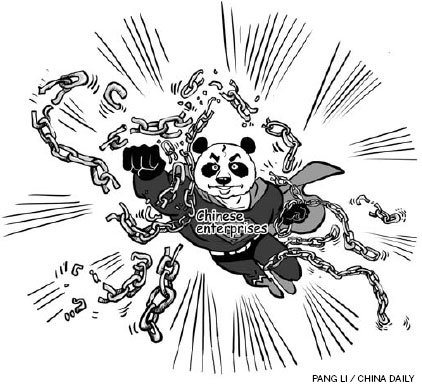
The development path of China's telecom equipment manufacturing industry, however, is becoming increasingly problematic, both economically and politically. Fearing that China would challenge its hegemony, the United States has dealt one blow after another to Chinese telecom equipment makers. As a result, Huawei and ZTE cannot function in the US market freely.
In 2008, the US used national "security concerns" to derail Huawei's proposal to join hands with Bain Capital, a politically reputable equity company, to acquire 3Com. Similar designs prevented the Chinese company from acquiring the wireless network division of Motorola. In 2010, Sprint Nextel excluded Huawei and ZTE from a contract worth billions of dollars, again because of Washington's "security concerns".
The US also prohibited Huawei from participating in the construction of its National Emergency Communications Network and stopped it from buying part of the assets of American computer company 3Leaf Systems. And on Oct 8, the Intelligence Committee of the US House of Representatives issued a report that said: "Huawei and ZTE cannot be trusted to be free of foreign state influence and thus pose a security threat to the United States and to our systems." The report recommends that US regulators block mergers and acquisitions by Huawei and ZTE in America and that US government computer systems not include any components from the two companies. The reason: Huawei and ZTE equipment can be used to send information to China through remote control.
Given the importance of the US' market in the global economy, Washington's move would create political risks for Chinese telecom equipment makers in other overseas markets, even though the accusation that the two Chinese companies pose a security threat to the US is untenable.
Many of the questions the House Intelligence Committee asked were related to crucial business secrets that could not be made public. Besides, the committee's report misunderstands and distorts the relationship between Chinese companies and commercial banks, and it revels in speculation instead of coming up with evidence. The report defies logic, because Huawei, ZTE and the Chinese military can never be "backdoor" espionage collaborators. How can a government whose "central task" has been "economic construction" for the past three decades engage two of its leading companies in "backdoor" espionage and jeopardize the future of the country's key industry?
The country that masters the art of "backdoor", as well as "open", espionage is the one that has enjoyed monopoly in technology for decades. And it knows that even if consumers discover that their systems have been compromised they can't do much to correct them.
Since the Chinese are latecomers to the global telecom equipment industry, the products made by companies such as Huawei and ZTE are highly substitutable. Had such companies been using their products for "backdoor" (or any other form of) espionage they would have been kicked out of overseas markets rather than becoming leading players in the telecom equipment sector.
Moreover, would Chinese decision-makers use as "espionage partners" companies whose products can be easily replaced? The reality is, Huawei and ZTE not only have excellent safety records, but also have taken a series of measures to improve transparency to win the trust of consumers. Despite Huawei occupying one-fifth of the global mobile communications equipment market and 45 of the world's top 50 telecom service providers using its products, no security incident has been reported so far.
Huawei has also taken a series of steps to improve transparency in the US market and offered its equipment for safety tests by a third party. But nothing, it seems, would make the US accept the facts.
In February 2011, Huawei issued an open letter to the US government, in which it allayed Washington's safety fears over its equipment and sought a thorough investigation into its business. Had Huawei been afraid of being found out would it have made such a move?
The House Intelligence Committee's report, though a setback for Huawei and ZTE, will not necessarily become the US' government's policy. And in case it becomes the US' official policy, the chain reaction would be too devastating for the American market to withstand. Therefore, Huawei and ZTE should not rush to abandon the US market.
Also, Chinese companies should give up the idea of wining Americans' trust by listing in the US, because such a move will cause many side effects. This is a lesson Chinese companies that went public in the US have learned. Instead, Huawei and ZTE should focus on improving their technologies further and make efforts to expand their shares in the markets of Europe, Japan, the Republic of Korea and emerging economies, where political risks are not as high as in the US.
So long as these markets grow faster than the US' (which is highly likely) and Chinese enterprises maintain and even increase their market shares in them, they don't have to worry too much about the setback in America. And patience will ultimately pay, because these companies' sustained efforts will prompt the US to shed its bias.
The author is a researcher at the Chinese Academy of International Trade and Economic Cooperation, affiliated to the Ministry of Commerce.


Copyright 1995 - . All rights reserved. The content (including but not limited to text, photo, multimedia information, etc) published in this site belongs to China Daily Information Co (CDIC). Without written authorization from CDIC, such content shall not be republished or used in any form. Note: Browsers with 1024*768 or higher resolution are suggested for this site.
License for publishing multimedia online 0108263 Registration Number: 130349