|
 |
|
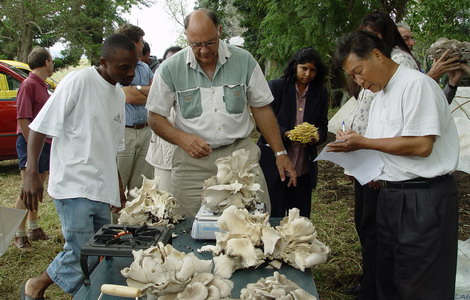
Lin Zhanxi (right), a Chinese researcher and inventor of a new type of mushroom-growing technology, harvests oyster mushrooms with locals at a demonstration center for the technology in KwaZulu-Natal Province, South Africa. [Photo / Provided to China Daily] |
The lessons learned in Frank Wangnapi's two-month trip to China will last a lifetime for the poor in his homeland Papua New Guinea.
The 45-year-old head of the Division of Natural Resources of the Eastern Highlands Province said he is more than willing to work hard - cutting grass, operating mixing machines and learning to distinguish species of mushrooms in the fields - as part of the training course on a new type of Chinese grass called Juncao, which can be used to cultivate edible and medicinal mushrooms.
The course, organized by the Fujian Agriculture and Forestry University under China's foreign-aid project, attracted 33 trainees from 17 developing countries this year, such as Papua New Guinea, South Africa and Fiji.
"I'll bring back the magic technology so that our farmers can learn the skills," Wangnapi said.
For many Chinese people, Juncao is an unfamiliar word. Jun means fungus and cao means grass, but the combination of the two Chinese characters can cause confusion.
"The basic idea of the technology is to grow grass and use the plant to cultivate substrates for mushrooms," said Lin Zhanxi, 69, who discovered this mushroom-growing technology.
"We offer training at home and abroad, send our experts to teach local farmers, and we do serve them heart and soul as our brothers," Lin said, who advocates sharing his mushroom-growing technology beyond China for years.
As a fungi expert, Lin said he first came up with the idea of using Juncao grass as a substitute for wood for producing mushrooms in the 1970s.
"Sawdust and wood chips were the conventional raw materials for cultivating mushroom," Lin said. "But it is a dilemma between developing the industry and protecting forests in China."
In 1971, Lin was the first person to suggest the idea of cultivating edible fungi in chopped-up wild grass. After an investigation in rural areas in Fujian province in 1983, he decided to conduct research to put his idea into practice.
"I saw people living on the barren red-soil lands starving, but growing mushrooms using grass is easy to learn and can bring quick returns, enabling local farmers to shake off poverty," he recalled.
At the end of 1986, Lin saw the first Juncao mushroom sprout from a bottle filled with a chopped wild fern in his laboratory.
Since then, Lin and his team have developed the technology by using 45 different kinds of grasses as Juncao fungi grass.

Copyright 1995 - . All rights reserved. The content (including but not limited to text, photo, multimedia information, etc) published in this site belongs to China Daily Information Co (CDIC). Without written authorization from CDIC, such content shall not be republished or used in any form. Note: Browsers with 1024*768 or higher resolution are suggested for this site.
License for publishing multimedia online 0108263 Registration Number: 130349