 |
|
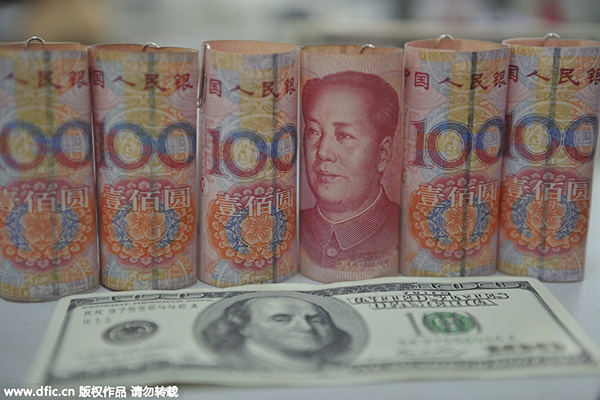
Chinese currency the yuan halted a three-day slide after the central bank soothed market sentiments on Thursday, reversing short but sharp declines triggered by a foreign exchange policy change. [Photo / IC] |
BEIJING - Chinese currency the yuan halted a three-day slide after the central bank soothed market sentiments on Thursday, reversing short but sharp declines triggered by a foreign exchange policy change.
On Friday, the central parity rate of the yuan strengthened by 35 basis points to 6.3975 against the US dollar, the first increase since the central bank adopted a more market-based forex rate formation mechanism on Tuesday.
The yuan's spot exchange rate also remained stable at around 6.4 against the US dollar. In China's spot forex market, the yuan is allowed to rise or fall by 2 percent from the central parity rate each trading day.
Friday's strengthening, after a three-day slump that knocked the yuan down 4.66 percent against the dollar, eased some concerns that it may be in for a period of long-term depreciation.
The People's Bank of China (PBOC) said on Thursday that there are no grounds for persistent and substantial depreciation of the yuan in the long run while vowing to step in to prevent excessive swings.
"The central bank is capable of keeping the exchange rate basically stable at an adaptive and equilibrium level," said Zhang Xiaohui, PBOC assistant governor.
The PBOC on Tuesday adjusted the exchange rate formation system to better reflect market development by closing the gap between a lower central parity rate and higher market expectations.
The yuan has been one of the strongest currencies in the world for years, as its nominal effective exchange rate has appreciated 46 percent since China initiated forex reforms by depegging the yuan from the US dollar in July 2005.
The improved mechanism takes into consideration the closing rate of the interbank forex market on the previous day, as well as supply and demand in the market, and price movement of major currencies.
The market reacted with surprise as the falling yuan led to a heavy sell-off in regional currencies, declines in Asian stocks and downward bulk commodities prices, as well as claims that the depreciation of the yuan was being engineered by China to rescue sluggish exports.
However, the central bank's move is probably not significant enough to make much difference to either exporters or buyers of Chinese exports.
Central bank economist Ma Jun said China does not need to start a currency war to gain advantage as trade is expected to pick up in the second half. Ma described the yuan's current rate as "near equilibrium."
A research note from HSBC also said the new forex policy is part of China's strategy to liberalize the yuan rather than a tool to support growth.
The International Monetary Fund (IMF) described the new policy as "a welcome step" that allows market forces to have a greater say in forming the exchange rate.
"Greater exchange rate flexibility is important for China as it strives to give market forces a decisive role in the economy and rapidly integrates into global financial markets," an IMF spokesperson said.

Copyright 1995 - . All rights reserved. The content (including but not limited to text, photo, multimedia information, etc) published in this site belongs to China Daily Information Co (CDIC). Without written authorization from CDIC, such content shall not be republished or used in any form. Note: Browsers with 1024*768 or higher resolution are suggested for this site.
License for publishing multimedia online 0108263 Registration Number: 130349