China's Xinjiang Oilfield reports CO2 storage and utilization breakthrough









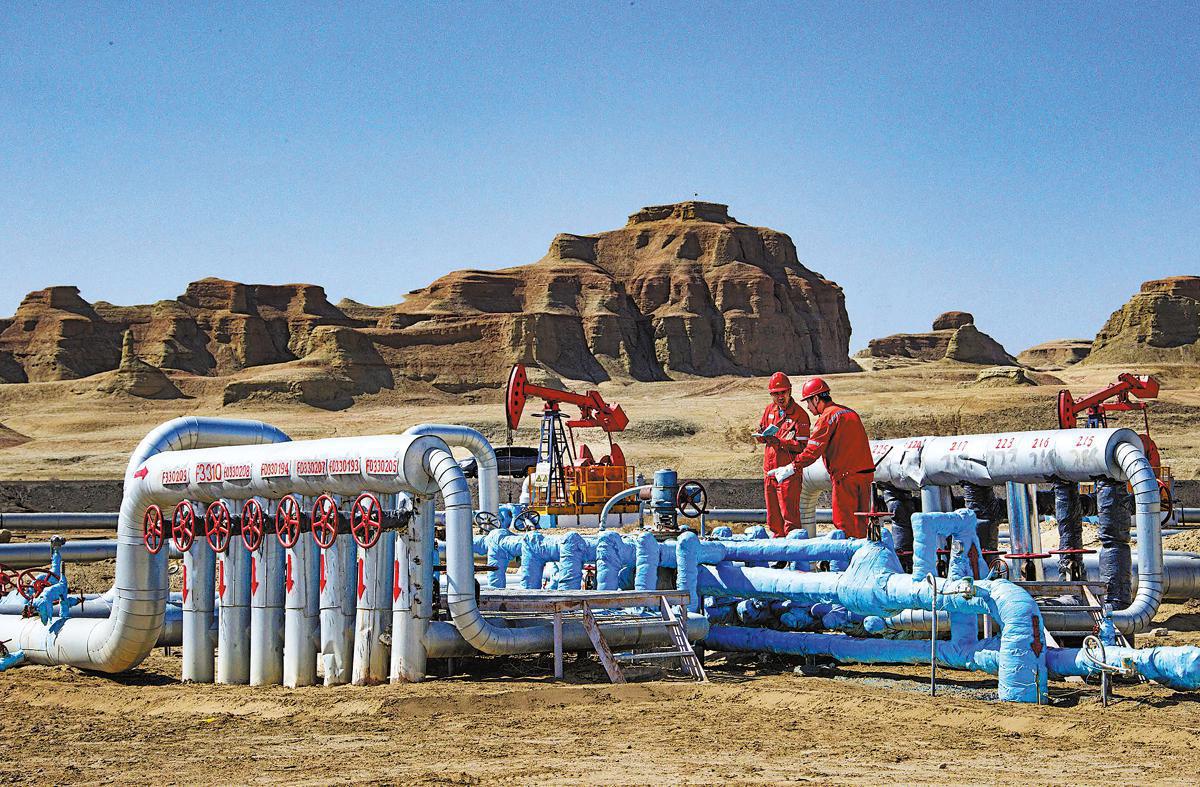
URUMQI -- Xinjiang Oilfield, a major oil production base in northwestern China, has achieved annual carbon dioxide (CO2) storage of over one million tonnes as of Dec 28, marking a breakthrough in the country's large-scale application of carbon capture, utilization and storage (CCUS) technologies, said China National Petroleum Corporation (CNPC) on Monday.
Located in the Junggar Basin in Xinjiang Uygur autonomous region, Xinjiang Oilfield is the first major oil producer of the People's Republic of China.
In recent years, the oilfield has explored CO2-enhanced oil recovery (CO2 EOR) methods by capturing emitted CO2 and reinjecting it underground to help form concentrated oil banks, sustaining high oil production with low-carbon approaches.
According to Shi Daohan, executive director and Party chief of Xinjiang Oilfield, one million tonnes of CO2 injected into the oilfield is equivalent to planting nearly nine million trees in terms of carbon storage.
Shi said the oilfield has overcome a series of technical challenges through management, technology and industrial innovations. Its annual CO2 injection has increased from 126,000 tonnes in 2022 to 1 million tonnes in 2025, achieving cumulative injections exceeding 2 million tonnes.
CCUS technologies like CO2 EOR are yielding a win-win outcome of emissions reduction and oil production growth, helping with both the country's dual carbon goals and energy security, said Ding Chao, head of the development division of Xinjiang Oilfield.
Xinjiang Oilfield's assessments suggest that its oil fields, which are suitable for CO2 EOR, and saline aquifers in the production area capable of storing carbon, have a potential carbon storage capacity of around 2 billion tonnes. This offers favorable conditions for developing a massive CCUS industrial cluster.
During the 15th Five-Year Plan period (2026-30), the oilfield plans to develop a 10-million-tonne CCUS capacity and promote integrated power projects combining new energy, coal-fired power and CCUS to support the green transformation of China's energy sector.
China has pledged to peak carbon emissions by 2030 and achieve carbon neutrality by 2060. As part of the effort, the country is aligning climate action with economic value creation, positioning low-carbon technologies as drivers of new markets and industrial transformation.

- China's Xinjiang Oilfield reports CO2 storage and utilization breakthrough
- New Year holiday projected to see over 2m daily trips
- PLA drills around Taiwan a necessary response, expert says
- PLA begins large-scale drill around Taiwan Island
- China reports achievement in forestry, grassland germplasm resources conservation
- PLA conducts live-fire training in areas north, southwest of Taiwan Island