Everyday acts of unity form the heartbeat of life in Xinjiang









Before my business trip to the Xinjiang Uygur autonomous region in September last year, I used to think "ethnic unity" was a lofty political phrase, something reminding us of official documents. That impression changed one afternoon on a community square in Korla in central Xinjiang. I saw a 74-year-old Uygur man, Qader Keyim, leading a "pomegranate seed art troupe" in singing a song, Blossoms of the Pomegranate.
He was playing the Xinjiang hand drum, called dap, with an elderly man of Han ethnic group accompanying him on the accordion and a Mongolian woman adding her high-pitched but mellifluous voice to the song.
At that moment, it was impossible to tell who belonged to which ethnic group. What you felt was a sense of togetherness and camaraderie. Scenes like this are common across Xinjiang, but what struck me most were the small, human stories.
In Aksu, a city level prefecture in southwestern Xinjiang, I met Zhao Wuzhong, a farmer from Sichuan province who traveled to Xinjiang in the 1990s to plant walnut trees on barren desert land. When a sandstorm nearly destroyed his young orchard, Zhao thought of winding up everything and returning home in Sichuan. It was a Uygur neighbor, Muheddin Tuerdi, who persuaded him to stay — and even lent him 10,000 yuan ($1,405), nearly all his savings.
"People thought he was crazy," Zhao told me, "but he said that he trusted me." Years later, Zhao's walnuts bore fruit. The first person he rushed to tell about it was Tuerdi, cycling to his house with a handful of fresh walnuts. Zhao later returned the kindness, teaching his neighbor new pruning and grafting skills that helped Tuerdi's older trees to yield far more walnuts than before.
Over the past two decades, the two families have become as close as those of brothers, celebrating holidays together and raising their children side by side. Unity here is not an abstract slogan; it is the help extended when someone is about to give up.
In Altay prefecture in far north Xinjiang, I heard the story of Alipa Alimahong, a Uygur mother who has been honored as one of China's "most inspiring women".
She adopted 10 orphans from Han, Hui, Uygur, Kazakh and other ethnic groups, in addition to raising her own children.
To pay for their schooling, she and her husband worked extra jobs and even sold the milk from their cows instead of keeping it for the family. "In my home," she said, "there is no difference between one child and another. They are all my children." Her household eventually comprised six ethnic groups and more than 180 people — a living symbol of what "a big family" means.
Such encounters convinced me that unity is not an abstract concept; it grows out of ordinary people's kindness, trust, and love for each other.
I also saw how broader policies and support make such unity more sustainable.
In Wensu county, which is part of Aksu prefecture, I visited "Jinhua New Village", once a poor settlement relocated in 2012 and renamed in gratitude for the support from Zhejiang province. Rows of houses stood amid apple trees and grape arbors, with a cultural hall and a community stage at the center. A young mother told me shyly, but with a smile: "My husband and I earn about 7,000 yuan a month. Healthcare is free, kindergarten is free, and our children enjoy 15 years of compulsory education in both Uygur and Mandarin."
Her words pointed to something larger: the strength of a system that shares resources across regions, so that no community is left behind. What I saw in Jinhua was not only better living conditions, but also the spirit of mutual help that makes unity a lived reality.
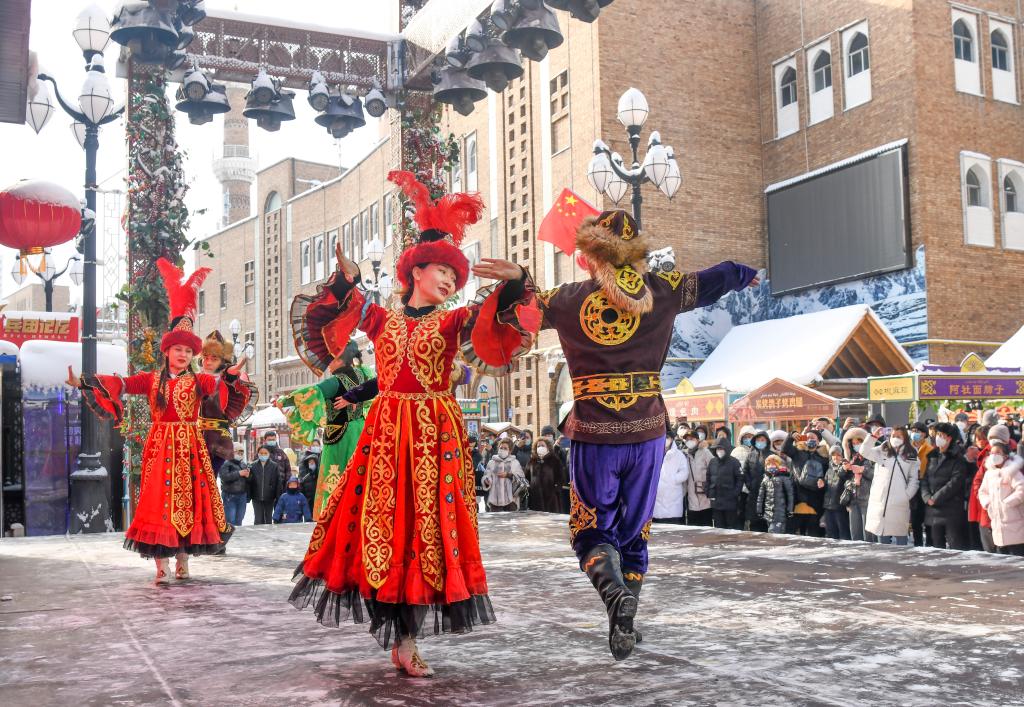
Xinjiang offers a powerful model of multiethnic harmony. There, I observed that cultural distinctions are celebrated, yet they do not lead to division. The bond could be a shared bowl of pilaf, a chorus and a dance on the square, the brotherhood born out of a walnut orchard, or a mother's embrace that crosses ethnic lines.
Ethnic unity, I came to understand, is far more than a symbol. It is the foundation for stability and development, for families to prosper and for regions to pursue modernization. This is not unique to the Xinjiang Uygur autonomous region or the country as a whole. It answers a universal question: How can people of different ethnic and religious groups not only live together but also help each other thrive?
Standing on the Korla square, I thought again of the metaphor Chinese leaders often use: the people of all ethnic groups should be "closely united like the seeds of a pomegranate that stick together".
It is an image that foreigners may be unfamiliar with, but after my visit to Xinjiang, I can say the use of the metaphor is exactly right. The seeds do not lose their own shape or flavor, but united together, they form something stronger, sweeter, and complete.
The author is a writer with China Daily.
The views don't necessarily represent those of China Daily.
If you have a specific expertise, or would like to share your thought about our stories, then send us your writings at opinion@chinadaily.com.cn, and comment@chinadaily.com.cn.