


Transplanting the East in Europe
Chinese influences, such as pagodas, paintings and ancient temples, inspired a desire in elitists for exotic garden designs, Zhao Xu reports.









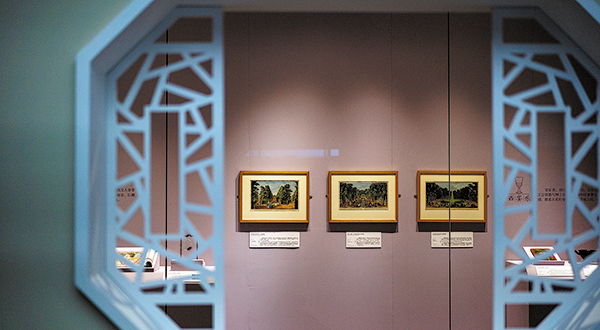
Suzhou Museum's exhibition, From the Humble Administrator's Garden to Monet's Garden, explores the confluence of Eastern and Western thoughts in garden design.[Photo by Suzhou Museum/For China Daily]
William Chambers (1723-96) wrote in his landmark Enlightenment-era book, A Dissertation on Oriental Gardening (1772): "Such is the common scenery of the Chinese gardens … their artists never fail to improve upon its singularities: their aim is to excite a great variety of passions in the mind of spectators; and the fertility of their imagination, always upon the stretch in search of novelty, furnishes them with a thousand artifices to accomplish that aim."
More than two decades earlier, Chambers made three trips to Canton (Guangzhou, Guangdong province) between 1745 and the early 1750s. The journeys left a lasting impression on the rising star of British architecture, who was officially named Architect to the King by George III in 1761. The following year, he was tasked with designing the Great Pagoda at the Royal Botanic Gardens, Kew, in southwest London, for Princess Augusta, the king's mother.
Today, the 10-story, 50-meter-tall pagoda still stands as one of the earliest major examples of Chinoiserie architecture in Britain — a European style inspired by Chinese and broader East Asian motifs.
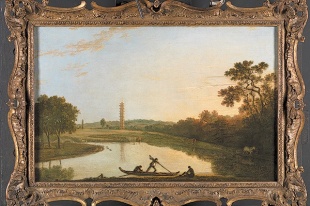
An oil painting of the pagoda by celebrated 18th-century British landscapist Richard Wilson is now on display at the Suzhou Museum in Suzhou, Jiangsu province, in the From the Humble Administrator's Garden to Monet's Garden exhibition, which explores the rich, two-way aesthetic and philosophical exchanges that shaped garden designs across the East and the West.
"Chambers' garden was modeled after the Great Bao'en Temple constructed in China during the 15th century. Since the original Great Bao'en Temple was largely destroyed in the ensuing centuries, Wilson's painting serves as a powerful reminder of the grandeur of its model," says Lyu Wentao, the exhibition's curator.
"It's also worth noting that the Great Bao'en Temple was largely funded by Zheng He, the renowned Ming (1368-1644) voyageur whose explorations reached as near as Southeast Asia and as far as East Africa, and represented a high point of exchange between ancient China and the rest of the world."
The Kew Gardens Pagoda is another fruit borne of such exchanges. "Jesuit missionaries began arriving in China in the late 16th century, and their travel accounts and letters home provided some of the earliest European descriptions of Chinese architecture, including the gardens. This imagery was further enriched by porcelain, lacquer-ware and woodblock prints imported to Europe by the British, Dutch, Swedish and other East India companies," says Lyu.