


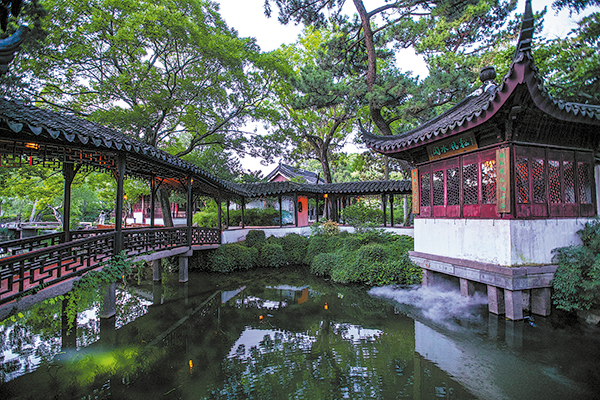
"'Though wrought by human hands, it appears in every way a creation of nature itself' — this, as set forth by a revered Ming Dynasty garden designer, became the ultimate benchmark of the literati garden," says Lyu.
"His theory rested on a time-honored belief among ancient China's educated elite that communion with nature fosters introspection and self-cultivation, virtues at the very heart of Confucian moral life."
Other currents of thought long woven into Chinese culture also flowed through the gardens, where the hushed passage of the seasons invited visitors to attune themselves to nature's spontaneous rhythms and contemplate its impermanence — reflections at the heart of Taoist and Zen Buddhist philosophy.
Many of these subtle layers of meaning may have eluded Chambers. He admired the variety of Chinese garden scenes, yet felt compelled to classify them in A Dissertation on Oriental Gardening as "the pleasing, the terrible, and the surprising".
"The first of these are composed of the gayest and most perfect productions of the vegetable world, intermixed with rivers, lakes, cascades, fountains and water-works of all sorts, being combined and displayed in all the picturesque forms that art or nature can suggest," wrote Chambers, who went on to elaborate the second category.
"Their scenes of terror are composed of gloomy woods, deep valleys inaccessible to the sun, impending barren rocks, dark caverns and impetuous cataracts rushing down the mountain from all parts."
Needless to say, "the surprising", as mentioned here by Chambers, corresponds to the sudden appearance of a pavilion at the turn of a bend, or a framed view opening through a wooden latticed window or a moon gate — the interplay between concealment and revelation that lends a Chinese garden its sense of wonder and perpetual discovery.
"While the Chinese scholar-officials who were often behind these gardens regarded their carefully constructed microcosms of ever-shifting views as prose imbued with the lyricism of poetry, their Western counterparts perceived them instead as staged dramas, orchestrated to evoke the full spectrum of emotions one might encounter in a Shakespearean theater," says Lyu.
Keeping that in mind, the Kew Gardens Pagoda, rising prominently above the pastoral setting of the British countryside, stands as a striking exclamation point, a bold architectural proclamation within an otherwise tranquil landscape.
If you go
9 am-5 pm (last entry at 4 pm), until Oct 23; closed on Monday (except on national public holidays);
Suzhou Museum, No 399, Changjiang Road, Huqiu district (High-Tech Zone), Suzhou, Jiangsu province.





