



Winged Lion of Venice has Chinese origin: Study









The famous and mysterious Winged Lion of Venice statue, which has watched over the beautiful Italian water city for more than 700 years, was made in China, scientists have discovered.
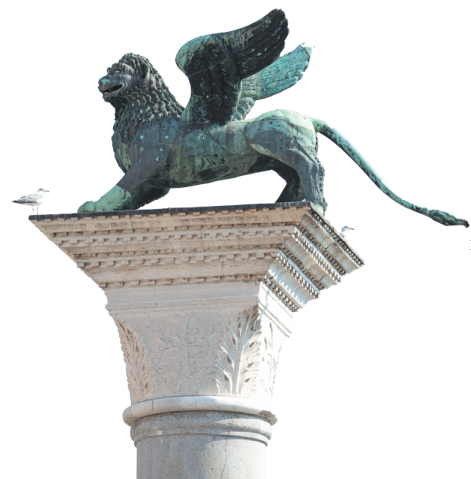
The ancient, 3,000-kilogram bronze lion that sits atop a granite column in Venice's iconic St. Mark's Square had long been thought to have been made in the "near East", likely in Syria or the Armenian Kingdom of Cilicia, around the year 300 BC.
However, scientists at Italy's University of Padua, who have analyzed the metal it is made from, are now certain that the statue was created in China during the Tang Dynasty (618-907) for use as a tomb guardian and subsequently taken to Europe, where it was modified to fit European expectations.
The startling discovery was revealed in a scientific study published in the latest edition of the journal Antiquity.
"It is possible that Marco Polo's father and uncle, during the four years they spent at the court of Kublai Khan during their first journey, were responsible for the acquisition of the sculpture," the researchers said, noting that the trip by the European explorers to the court of the ruler — who was also known as Emperor Shizu of Yuan — likely took place between 1264 and 1268.
In addition to deducing that components of the bronze were extracted from the Lower Yangtze River basin, the scientists observed that the 4-meter-long, 2.2-meter-tall statue originally featured horns and longer ears, with a nose resembling that of a Chinese lion statue rather than a European one.
They said it looks as if the statue was "discreetly and laboriously refitted" to make it look more like the winged lion, the holy emblem of St. Mark, the patron saint of Venice.
In addition, they said that the "puzzling absence of written information" about the statue's early years in Europe means "the intention and logistics behind its journey to Venice remain elusive and open to interpretation".
"If the installation … was meant to send a strong, defensive political message, we can now also read it as a symbol of the impressive connectedness of the medieval world," they added.
They speculated that the statue may have been transported more than 9,500 kilometers along the Silk Road trading route between Asia and Europe.
"Venice is a city full of mysteries, but one has been solved," Massimo Vidale, from the University of Padua, told the Press Association.
However, "when the sculpture arrived in Venice, where it was reworked, who did it, or when it was erected on the column where it is still visible today" remain unknown, he said.
Despite the uncertainties, the scientists say that lead isotope analysis indicates there is no doubt the statue originated from China, and that it had the posture and features of a tomb guardian.










