



Chinese chipmakers thrive despite curbs
US bid to curtail access to advanced tech counterproductive, insiders say









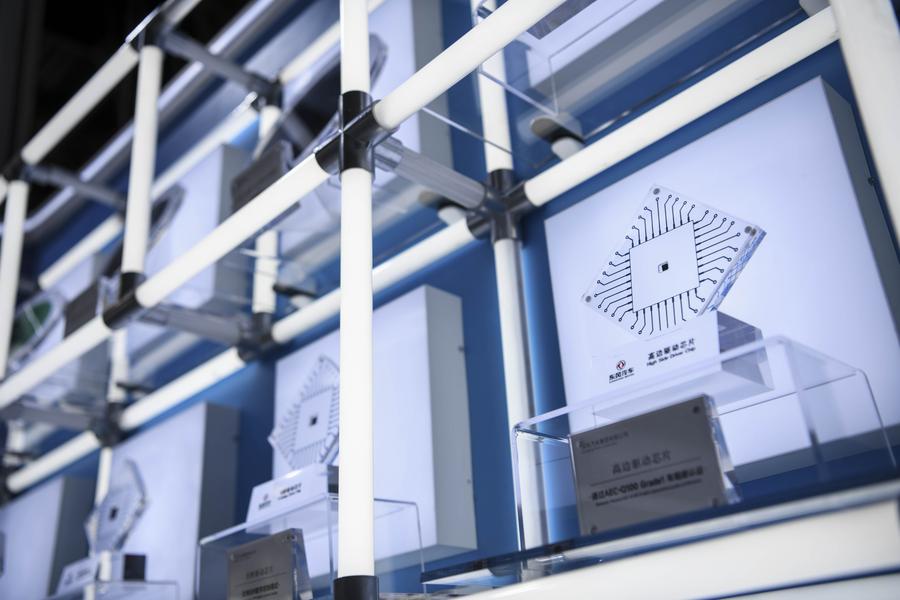
China is accelerating its semiconductor production, which is essential for artificial intelligence development, despite facing US export controls, according to recent industry reports.
The advancement comes as US efforts to curtail China's AI capabilities have been criticized by industry experts as counterproductive, with China demonstrating remarkable adaptability in overcoming trade barriers.
A new report from Jefferies, a New York-based investment bank, highlights how China has strategically reallocated semiconductor manufacturing equipment to domestic firms best suited to utilize it.
Leading this expansion is Semiconductor Manufacturing International Corporation, China's largest chipmaker. The company is actively expanding production in Shanghai, Shenzhen and Beijing, with production reaching nearly 50,000 microchip wafers per month this year, according to the report.
The Jefferies report suggests that Huawei, in turn, could leverage the expanded infrastructure to boost production of its latest AI processor — the Ascend 910C. The chip is central to Huawei's AI computing system CloudMatrix 384, which is being positioned as a domestic alternative to Nvidia's GB200 NVL72.
Facing restrictions on accessing high-end AI processors, Huawei has adopted an innovative approach of deploying greater numbers of processors compared to international competitors to achieve comparable AI performance levels.
Independent research from AI and semiconductor analysis firm SemiAnalysis has confirmed that Huawei's CloudMatrix 384 directly competes with Nvidia's GB200 NVL72, a rack-scale, high-performance AI solution.
Huawei's solution "in some metrics is more advanced than Nvidia's rack-scale solution", SemiAnalysis said in an April analysis.
Despite using chips that are technically a generation behind, "Huawei is pushing the limits of AI system performance", the firm said, noting that the company's scale-up solution is "arguably a generation ahead of Nvidia and AMD's current products on the market".
To further offset US controls, Chinese firms are creatively adapting consumer-grade hardware for AI use. The Jefferies report said that personal gaming computers are being used as "AI inferencing workstations", reflecting the sector's resilience and innovation under constraints.
Infrastructure advantage
China's infrastructure advantage — including ample electricity, low land costs and rapid expansion of cooling facilities — adds to the country's ability to scale semiconductor and AI development quickly and cost-effectively, the report added.
A separate report released last week by market intelligence firm Yole Group forecasts that by 2030, the Chinese mainland will account for 30 percent of global foundry capacity, establishing itself as the world's largest chip manufacturing hub.
In 2024, China held 21 percent of foundry capacity while accounting for just 5 percent of global wafer demand, according to the latest foundry industry report.
By comparison, the United States remains the world's largest wafer consumer, responsible for 57 percent of global demand, but controls only 10 percent of domestic foundry capacity.
Since the US initiated what industry observers term a "semiconductor-focused trade war", the Chinese mainland has accelerated efforts to construct a "self-sufficient domestic ecosystem", according to the Yole Group report.
Despite continued efforts by both the Trump and Biden administrations to curtail China's access to advanced chips, leading US tech firms and policy experts warn that the strategy is proving counterproductive and potentially accelerating Chinese innovation while incentivizing domestic firms to replace US suppliers.
While US firms dominate global chip design, they remain heavily reliant on foreign manufacturers.
Nvidia, which reported a financial impact of $5.5 billion due to export controls, has cautioned that such restrictions risk isolating US companies from global markets.
"Rather than slowing China's ascent, the US government is hastening it," said a report by the Information Technology and Innovation Foundation in May, pointing to Huawei's rapid development of the Ascend chip series as a direct result of US restrictions.
"Huawei isn't the only player that is helping China close the gap. China has firms innovating and competing across all layers of the chip ecosystem. Companies such as Biren Technology, MetaX, and Enflame are designing AI chips," said the ITIF report.
"Moreover, China is innovating on how to deploy less efficient chips more effectively," it said.
liazhu@chinadailyusa.com










