



Trilateral ties deepen for shared growth
Leaders of ASEAN, GCC, China reject protectionism and push for resilience









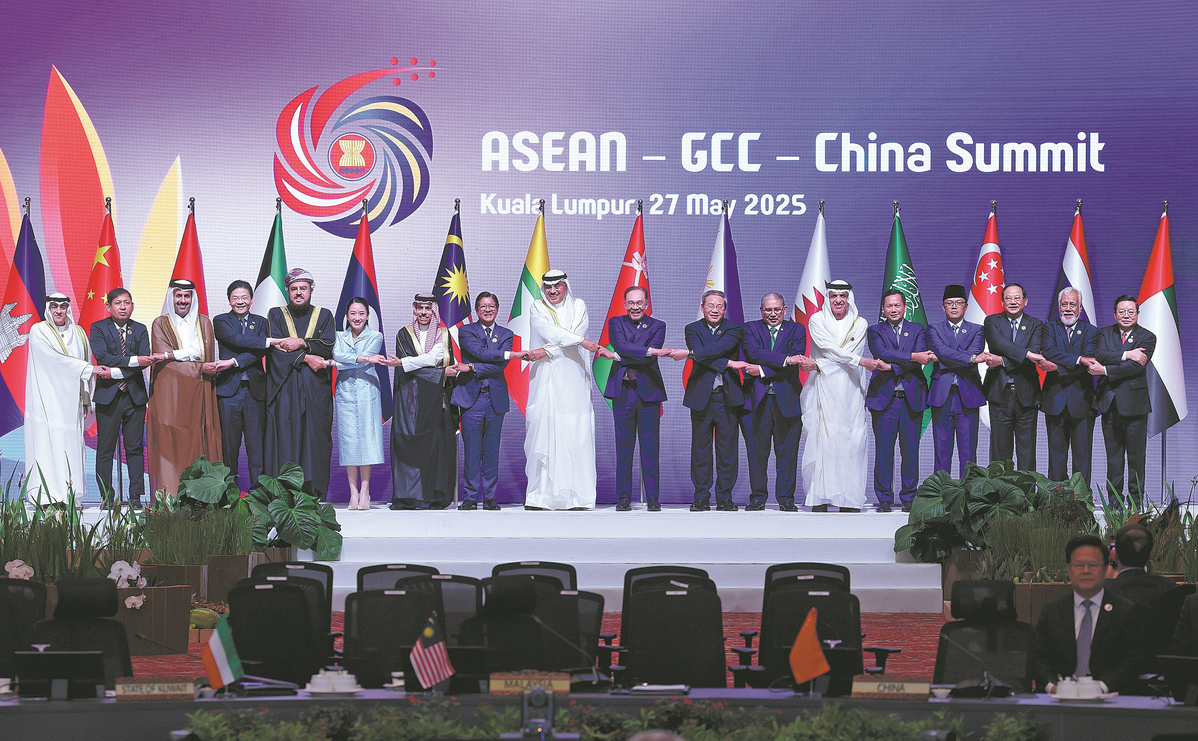
The first trilateral summit of China, the Association of Southeast Asian Nations and the Gulf Cooperation Council strengthened economic cooperation and broadened trade and diplomatic alliances as the Global South faces uncertainties brought by rising tariffs, analysts say.
The inaugural ASEAN-GCC-China Summit, held on Tuesday in Kuala Lumpur, Malaysia, was in conjunction with the 46th ASEAN Summit, with Malaysia serving as the bloc's rotating chair.
Malaysian Prime Minister Anwar Ibrahim said ASEAN's engagements with the GCC and China "marked significant progress".
"No longer merely formal in nature, the deliberations this time were far more thorough, covering issues such as tariffs, joint projects and our shared role in promoting regional peace and stability," Anwar said on social media.
In a joint statement, leaders of the three parties made commitments to fostering collaboration that promotes economic prosperity, resilience and sustainable development.
They also reaffirmed the central and indispensable role of the World Trade Organization at the core of the rules-based multilateral trading system, which provides a predictable, transparent, nondiscriminatory and open global trading system.
In addition, the leaders expressed grave concerns over the developments in the Middle East and condemned all attacks against civilians.
They also called for a durable ceasefire and for all concerned parties to ensure the most effective and efficient access to humanitarian aid, relief supplies and other basic necessities and essential services. They urged the restoration of electricity and water, and the unhindered delivery of fuel, food and medicine throughout the Gaza Strip.
The leaders resolved to enhance economic resilience and environmental sustainability, and make economic globalization more open, inclusive, balanced and beneficial to their peoples and future generations.
'Dynamic' regions
Joanne Lin Weiling, a senior fellow and co-coordinator of the ASEAN Studies Centre at the ISEAS-Yusof Ishak Institute in Singapore, said the ASEAN-GCC-China Summit has brought together three of the "most dynamic regions in the Global South at a time of heightened global trade tensions".
Amid the United States imposing punitive tariffs on all its trading partners, Lin said the trilateral meeting "took on added urgency "as the three sides "face the ripple effects of an increasingly fragmented global economy".
"The summit sent a clear message that ASEAN, the GCC and China are looking to build new economic partnerships that are not beholden to traditional power centers," she said.
While the trilateral format is still new, it also shows a growing appetite for the Global South-led cooperation that can buffer against external shocks and promote more equitable economic integration, she said.
Global South solidarity
Nawazish Mirza, a professor of finance at Excelia Business School in France, said the summit signaled "a proactive shift toward shaping an alternative, multipolar economic architecture grounded in Global South solidarity".
It also strategically repositioned the three parties to diversify their markets and mitigate supply chain vulnerabilities, Mirza said.
The summit gathered three of the world's largest economies, with their combined GDP reaching nearly $25 trillion.
China is ASEAN's largest trading partner and one of the region's biggest sources of tourists and investment.
ASEAN-GCC trade was growing even before the summit, with bilateral trade estimated at $130.7 billion in 2023. This was the second time the two regions convened a summit, with the first in October 2023 in Riyadh, Saudi Arabia.
Josua Pardede, chief economist of Permata Bank in Jakarta, Indonesia, said ASEAN's huge population of more than 670 million presents a "sizable, vibrant market fit for their (GCC nations') diversification objectives".
Stronger links also promote people-to-people exchanges, regional stability and multilateralism, Pardede said.
Awang Azman Awang Pawi, a professor at the Academy of Malay Studies in the University of Malaya, said shifting this year's summit from Riyadh to Kuala Lumpur "indicates equal partnership, not just GCC-led initiatives".
The summit represents "multilateral resilience", showing that even amid great power rivalries, emerging economies can formulate alternative trade and investment arrangements, he said.
prime@chinadailyapac.com
Leonardus Jegho in Jakarta contributed to this story.










