


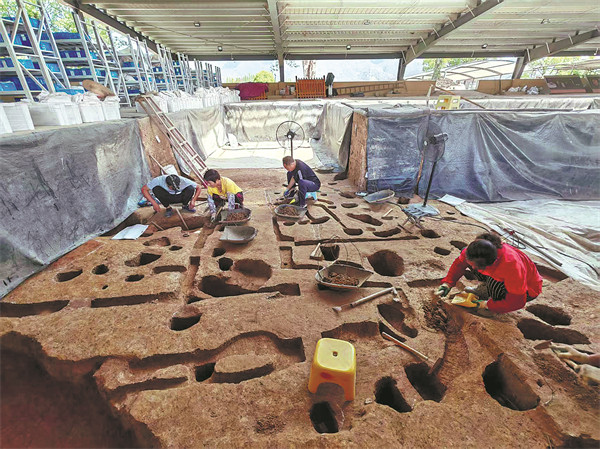
Foundations, road and tombs suggest site is 9,000 years old, Fang Aiqing reports.
At Xiatang village in Xianju county, East China's Zhejiang province, remains of a primitive village more than 9,000 years old have been discovered. There, residents of this ancient settlement cultivated rice, built houses, and fired pottery over a span exceeding 5,000 years.
Excavations conducted in 2018 and from 2022 to 2024 that cover an area of 2,250 square meters — less than one-third the size of a standard soccer field — have revealed the general layout of the village. Various necessary components of an agricultural society, such as house foundations, a food processing base, a ditch, a road and tombs, have been found.
Chen Xingcan, a researcher at the Institute of Archaeology, Chinese Academy of Social Sciences, says: "The Xiatang archaeological site is one of China's earliest known settlements with agricultural practices. It presents a panoramic view of the settlement forms and structures of an early agricultural society, providing a vital specimen for studying the early rice farming societies in southern China."
In late April, the site was included among the country's top 10 archaeological discoveries for 2024, jointly released by the China Cultural Relics News and the Society for Chinese Archaeology. The annual list is recognized as one of the highest domestic honors in archaeology.
Discovered in 1984, the Xiatang site is located at the center of a basin, elevated 1 to 2 meters above the surrounding farmland and covering an area of around 30,000 sq m. It's flanked by rivers on the east and west, and around 2 kilometers to its south is the Lingjiang River, Zhejiang's third-largest water system.
Cultural layers of the site — referring to stratified soil and material deposits with each layer representing a distinct period of human activities — has reached 2.5 meters, encompassing the periods of Shangshan (c. 8000-6500 BC), Kuahuqiao (c. 6300-5200 BC), Hemudu (c. 5000-3300 BC) and Haochuan (c. 2500-2000 BC) cultures.
Zhong Zhaobing, a research librarian at the Zhejiang Provincial Institute of Cultural Relics and Archaeology, leads the excavations of Xiatang. He says that the site is unique across China as this single ancient settlement lasted 5,000 years and spanned the entire Neolithic period.
"It serves as crucial evidence for the independent origin and continuous development of China's 10,000 years of cultural history," he adds.
While rice farming originated in the Yangtze River Basin, the Shangshan culture — the earliest known Neolithic culture in the lower reaches of Yangtze River — is considered the cradle of the cultivation.
A research team led by Lyu Houyuan from the Institute of Geology and Geophysics at the Chinese Academy of Sciences found that wild rice was prevalent at the regions influenced by Shangshan culture as early as around 100,000 years ago. About 13,000 years ago, human ancestors started to grow rice, and around 2,000 years after that, domesticated rice emerged. The findings were published by the international academic journal Nature in May 2024.





