A celebration for a time of promise
Spring Festival enjoys a growing global profile with recent UNESCO heritage recognition. Zhao Xu explores the cultural roots of this age-old tradition and how it has evolved over time.










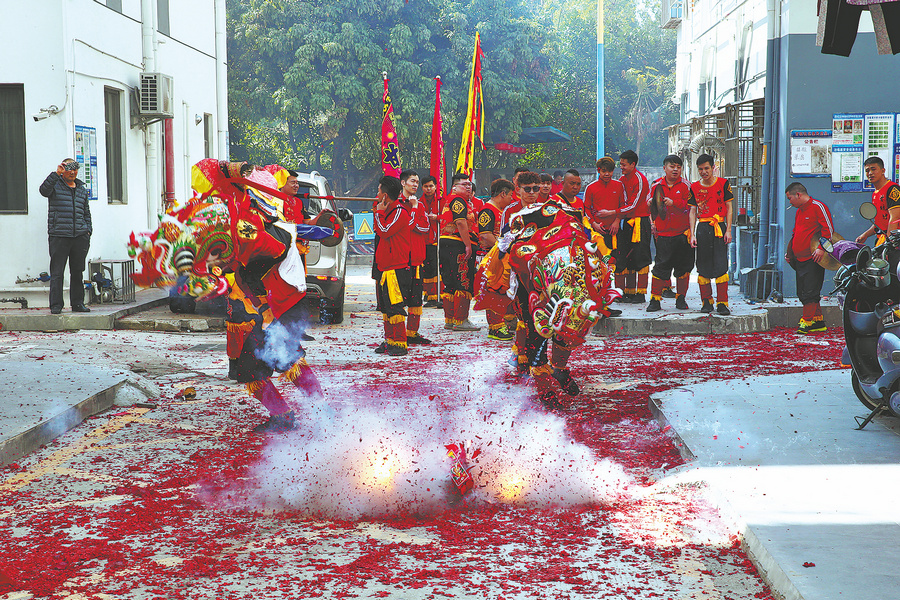
As Wang rightly noted, the old year would only depart at the ear-splitting sound of firecrackers — tiny thunderclaps that rattle street-level windows, send children cupping their ears in delight and leave a confetti of shredded red paper that once wrapped the fiery explosives.
Yet, few know that the firecrackers we recognize today only emerged during Wang's time, as gunpowder — first invented by the Chinese around the 9th century — advanced significantly due to the frequent warfare between the Song Dynasty (960-1279) and its neighbors.
Before that, the sharp, explosive sound was made by igniting dried bamboo stalks, which is why the Chinese name for firecrackers is bao zhu, meaning "bamboo burst". Alternatively, the resounding crack could be produced by snapping a whip, giving firecrackers the name bian pao, meaning "whip blast".
While the firecrackers create a chaotic symphony full of energy, it is not to delight the ears, but to drive away a ferocious beast, according to legend.
This beast, named Nian — the same character for "year" — once struck terror in the villages, until a wise old man discovered that despite its apparent invincibility, Nian feared three things — loud noises, bright lights and the color red.
Thus, firecrackers explode at night, candles flicker until dawn, and lanterns sway from every rooftop. The color red appears everywhere, from scarlet couplets and paper-cut window decorations to red envelopes filled with money, gifted to the younger generation as a blessing of good fortune.
How did Nian come to be seen as a force of destruction? Cultural historians have long pondered this, suggesting it may be tied to winter's unforgiving nature. Yet, with the arrival of the new year comes a gentle assurance — a chance to triumph over misfortune, the weight of the past, and the person we once were.
"All the passing years lay behind me, like distant mountain ranges … separating me from my childhood," wrote venerated Chinese author Ba Jin (Li Yaotang, 1904-2005) in Ring in the New Year (Guo Nian), recalling how, as a boy, he once burned his cotton-padded shoes with firecrackers during an unforgettable New Year's moment.
He confessed that even if he could return to that sweet childhood dream, he would not, for he had to confront the pain of his soul and his duty "to love his much-suffered countrymen and to fight for freedom and peace".
Ba Jin wrote this in 1934, during the War of Resistance Against Japanese Aggression (1931-45).
In those dark and uncertain times, Chinese New Year was no mere celebration. It stood as a testament to resolve, a solemn reminder that even traditions rooted in millennia could crumble if not fiercely protected, sometimes at the cost of life.