Lore of the rings










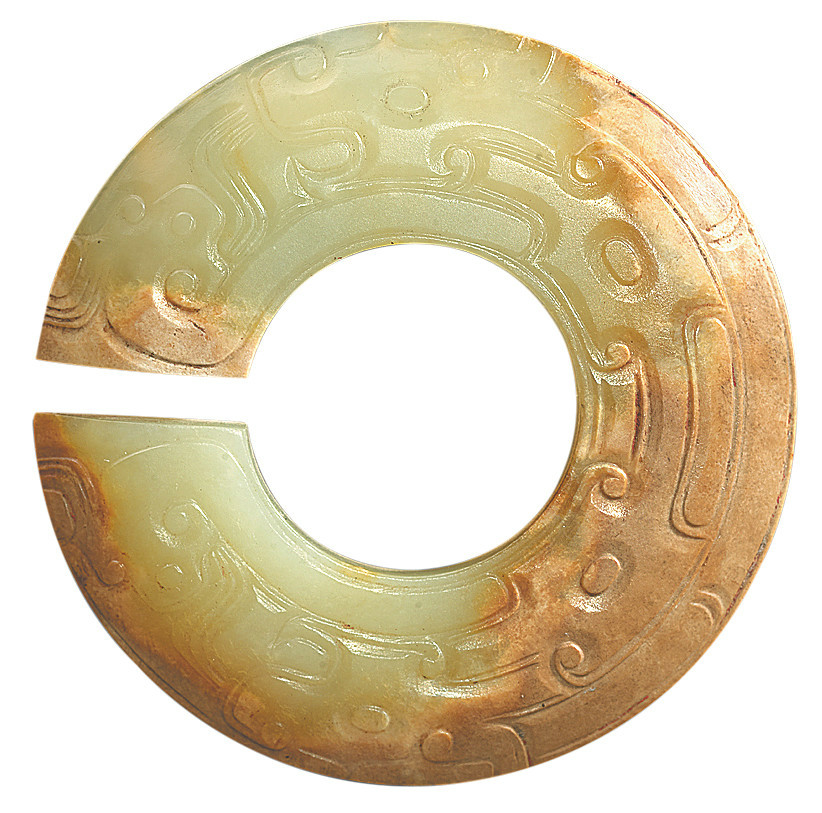
Nephrite jade is different in that its unusual obdurateness forbids the easy separation of one part from the rest by means of chipping. Besides, it was simply too precious to be treated in a haphazard manner, which would almost certainly cause huge waste and would never be able to produce the delicate shapes intended for the material by its handlers.
String saw — that was the answer to the problem from the jade artisans of Xiaonanshan. Chunks of jade were sliced apart as the string, sturdy enough to sustain the repeated friction, was pulled back and forth against the jade's surface until it started to sink, deeper and deeper, into the material. More than that, the technique proved very effective when it came to achieving precise and minute control over the shaping of the material — traces of string sawing, visible as a series of curved undulations, can be found in the slits of the Xiaonanshan jue.
"In Chinese, we have the phrase 'yi rou ke gang', meaning 'to subdue the strong with the gentle'," says Zuo. "It conveys the idea of employing a flexible approach to overcome or deal with a powerful, rigid force, an idea embraced by almost everyone in ancient China, from philosophers and military strategists to martial artists.
"Yet, few had any idea that the use of a string saw, as we call it today, was perhaps one of the earliest and most successful attempts at breaking the seemingly unbreakable using subtle force, applied resolutely and relentlessly," he says.
While the string saw was doing its job, abrasives like quartz sand were continually added where the string chafed against the jade. They were moist, and therefore clingy, following the movement of the string. The aim was to expedite the reduction of jade with the help of a tougher material. (The nephrite grains resulting from this process served the same purpose.)
In a seminal piece of writing, Tang Chung, a leading expert in ancient Chinese jade, suggests a possible link between the string saw and the hunting bows widely used during the Neolithic period. In both cases, an extremely tough cord — believed to have probably been made of wild bull or deer tendons — was involved.