



China slams IAEA's 'nod' for Japan's plan









UN nuke agency fails to include views of experts who took part in review, FM says
China on Tuesday expressed regret over a report from the International Atomic Energy Agency that granted Japan approval for dumping radioactive water into the ocean.
In a Chinese Foreign Ministry statement, a spokesperson from the ministry said the report failed to fully reflect the views of experts who participated in the review, and the conclusion was not shared by all experts.
"Due to its limited mandate, the UN nuclear agency failed to review the justification and legitimacy of Japan's ocean discharge plan, to assess the long-term effectiveness of Japan's purification facility, or to corroborate the authenticity and accuracy of Japan's nuclear-contaminated water data. Therefore, the conclusion is largely limited and incomplete," the spokesperson said.
Earlier on Tuesday, IAEA Director-General Rafael Grossi handed a review report to Japanese Prime Minister Fumio Kishida in Tokyo, in which he said in a foreword to the report that "controlled, gradual discharges of the treated water" into the Pacific Ocean "would have a negligible radiological impact on people and the environment".
In response, the Chinese ambassador to Japan denounced the report, saying the assessment cannot be used as a "license" by Japan to dump radioactive water.
"The IAEA is an international organization that promotes the safe, reliable, and peaceful use of nuclear technology from a functional perspective, so it is not an appropriate organization to assess the long-term impact of nuclear-contaminated water on the marine environment and biological health," Wu Jianghao, China's ambassador to Japan, told a news conference in Tokyo.
"It should also be noted that Japan has limited authorization of the IAEA working group and refused to accept the assessment of alternative disposal methods," Wu added.
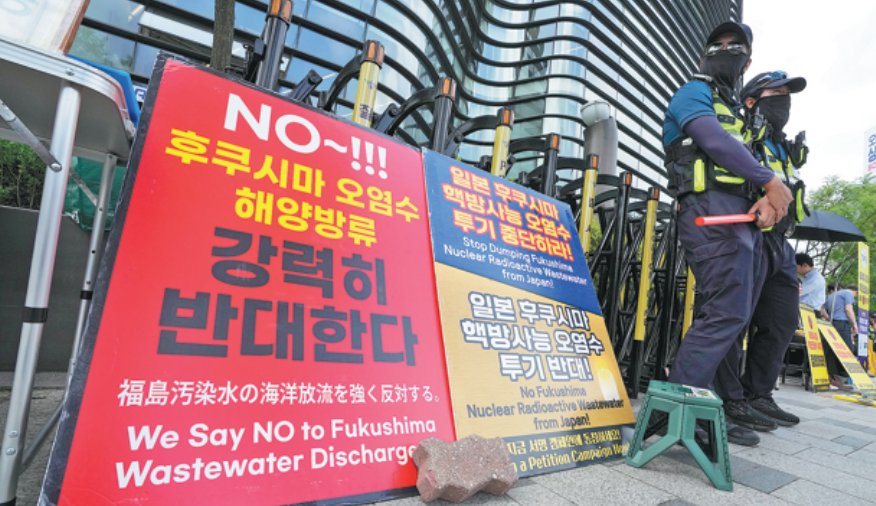
The assessment drew harsh criticism right away as Japan's dumping plan had long provoked serious concerns from neighboring countries and sparked public protests in several cities across Japan and South Korea. It also faces opposition from a majority of local residents and members of Japan's fishing industry.
"That the water must not be released without the consent of all those involved is the promise of the government, but now they are doing exactly the opposite," said Tetsu Nozaki, head of the Fukushima Prefectural Federation of Fisheries Cooperative Associations.
Hisae Unuma, one of the Fukushima residents who is unable to return to her home because of the 2011 disaster, is feeling betrayed since she had, over the years, dedicated herself to making stronger calls among ordinary Japanese for the government to scrap its decision.
"Dumping toxic water is contrary to the government's pledge of rebuilding my hometown of Fukushima. It threatens a double blow to our community. And now, I just don't know what to say. I guess, that's real helplessness," said Unuma.
Meanwhile, the credibility of the IAEA's report has been questioned as South Korean media recently revealed the Japanese government has made a political donation of more than 1 million euros ($1.10 million) to the IAEA in order to resolve differences in opinion between the IAEA and third country experts conducting the review.
The reports quoted unidentified sources as saying the Japanese government had obtained the draft final assessment from the IAEA's working group in advance and proposed substantive amendments so they can exert undue influence on the final conclusions.
Both the Japanese government and the IAEA have yet to give a convincing explanation to the reports.
Liu Qingbin, a former professor at Yokohama National University's Institute of Advanced Sciences in Japan, said the special structure the Japanese government has devised to deal with Fukushima has already made it impossible for people to trust Japan.
"The government, which had been championing nuclear power, made Tokyo Electric Power Company own up to its responsibility. By keeping the power company afloat to safeguard shareholders and bank lenders, it used public funds to establish the Nuclear Damage Liability Facilitation Fund to grant loans to the company to deal with the disaster," Liu said.
"This arrangement conveniently enabled the government to evade responsibility for the nuclear cleanup, and how on earth could the party that created the mess be the only one to handle it," Liu added.
Contact the writers at wangxu@chinadaily.com.cn.










