Book on oracle bones published









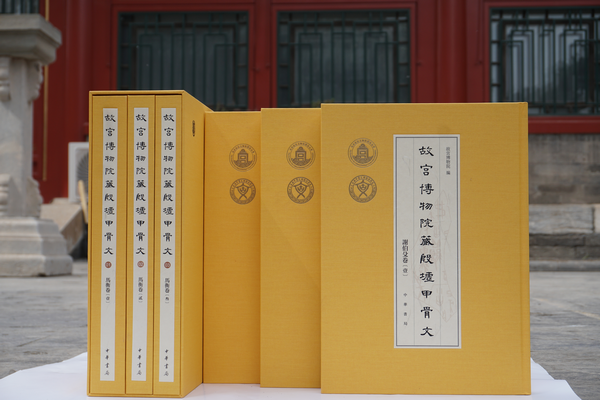
The Forbidden City, China's imperial palace from 1420 to 1911, which is now officially known as the Palace Museum, is not just famous for its extensive collection of royal relics and its unique architecture but is also a treasure trove of archaic characters.
After a decade of study and preparation, the museum announced on Monday that it was releasing a multivolume book on some of the 3,300-year-old oracle bone inscriptions in its collection.
The recently published first two volumes of the book, Yinxu Oracle Bone Inscriptions in Palace Museum Collection, cover more than 1,300 bones, the inscriptions on which include topics ranging from military affairs, astronomy and agriculture to tribute systems and sacrificial rituals.
This is the first time in decades that China's largest museum has decided to make public details about its oracle bone collection through a book.
Dating to the late Shang Dynasty (c.16th century to 11th century BC), oracle bones — inscribed turtle shells and ox scapulas, among others — were mainly excavated from the Yinxu Ruins site in Anyang, Henan province. The script comprised the earliest-known, fully developed Chinese writing system whose lineage is the same as the Chinese characters used today.
In 2017, the inscriptions were included in the International Memory of the World Register, administered by UNESCO, which seeks to identify items of documentary heritage that have worldwide significance.
In 2019, President Xi Jinping praised the oracle bone inscriptions, saying they represent the roots of fine traditional Chinese culture, in a congratulatory letter to mark the 120th anniversary of their discovery.
Zhu Hongwen, deputy director of the Palace Museum, said the museum houses 21,395 oracle bones, about 13 percent of the world's total number of such relics known to exist today.
Although this is the third-largest collection of oracle bones among institutions, after the National Library of China and Taipei-based Academia Sinica, about 80 percent of these bones were never categorized. It was the world's last big collection of oracle bones that had largely remained untouched.
The Palace Museum used to be a hub for oracle bone studies. However, after veteran scholars died, inheritors of this crucial and difficult discipline remained absent at the institution for about three decades after 1981. Finally, in 2013, scholars at the Palace Museum began to categorize and study the oracle bones to resume the course.
According to Wang Su, a researcher at the Palace Museum who has led the ongoing oracle bone studies, the recently published volumes focus on bones that were collected by Ma Heng, former director of the museum, and Xie Boshu, an entrepreneur and a paleographer.
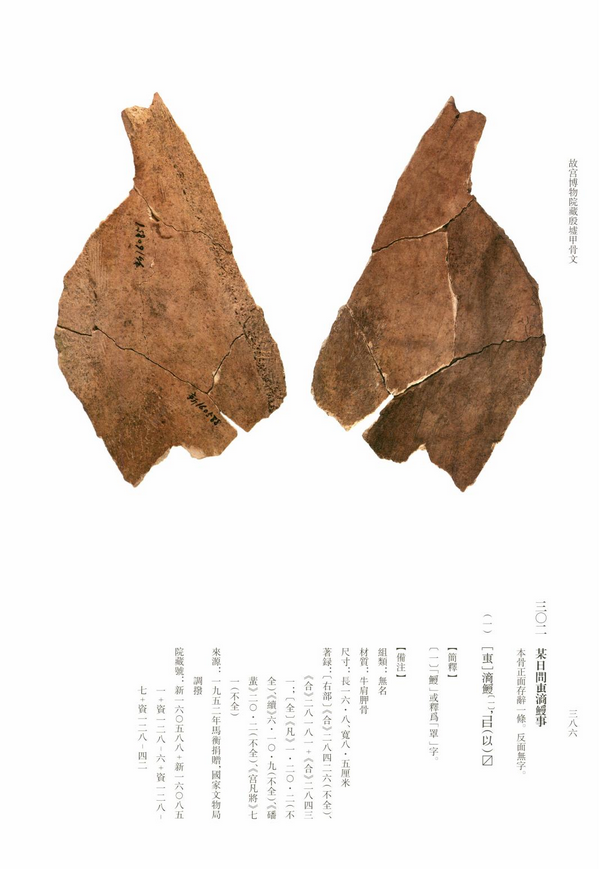
Pictures and stone-rubbing replicas of each piece of oracle bone, along with explanatory notes, have been included in the book.
"We have also named every bone to indicate its nature and content, and thus facilitate further research. For the first time, the collection of oracle bones features catalogs like regular books," Wang said.
Previously, oracle bones only had serial numbers. Liu Yiman, a veteran oracle bone researcher with the Chinese Academy of Social Sciences, said: "Sorting files properly is the key for academic breakthrough. New materials can broaden our horizons."
The book on the Palace Museum's oracle bone collection can provide references for studies on warfare during the Shang Dynasty, and on a rare recording of a solar eclipse, Liu added.
In 2020, a comprehensive academic project was co-launched by the Ministry of Education and other national-level authorities to highlight the importance of paleography in inheriting and developing the Chinese civilization.
"Exploring the thoughts and cultural meanings hidden in the oracle bone inscriptions is the main work in this project," said Liu Hong, deputy director of the Ministry of Education's language information management department. "By figuring out cultural symbols of the past, we can better trace the origins of our civilization."
The Palace Museum also released its first essay collection on paleography on Monday. Besides the oracle bones, the museum houses about 1,600 inscribed bronze wares from the Shang and Zhou (c.11th century to 256 BC) dynasties.
wangkaihao@chinadaily.com.cn





- Beijing community leads the way in grassroots governance
- HKSAR govt extends thanks to various units for supporting people affected by residential complex fire
- Influencers barred from vulgar, false, or harmful content
- Hangzhou–Quzhou High-Speed Railway begins operations
- China records rise in survival prospects for child and adolescent cancer patients
- Ministry unveils draft revision of the national air quality standards