Vertical farming reaches new heights










Superior yields
Yang said that in China, about 250 plant factories use vertical farming.
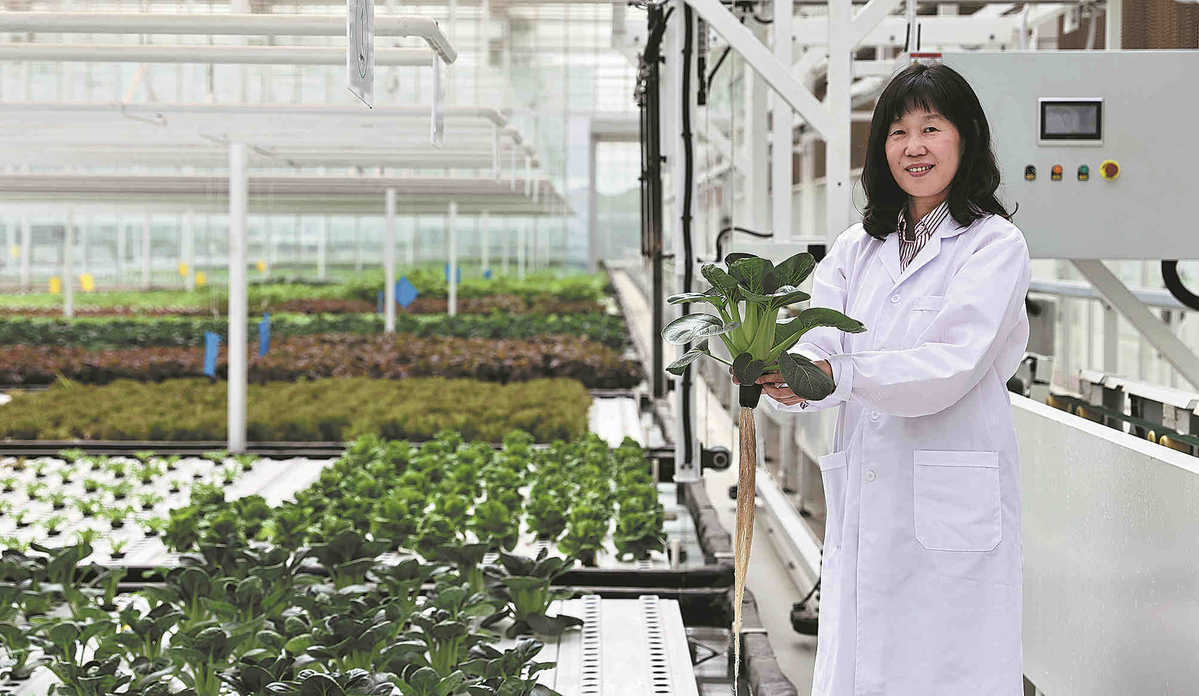
Beijing AgriGarden Protected Horticulture Technology Co, which was established in 2002, is one of the first such companies in the country to use vertical farming. Located at the National Agricultural Science and Technology Innovation Park in the Zhongguancun area, the company boasts seedling laboratories, vertical farming planting areas, ecological meeting rooms, and garden offices.
A workshop at the park, which grows cucumbers on an area of more than 1,000 sq m, achieves a yield of over 200 kg. Four varieties of cherry tomatoes produce an annual yield of 20 kg per sq m, while strawberries planted at the farm boast a far superior yield to traditional planting methods.
In a glass greenhouse, a robotic arm carries vegetable seedlings individually to a 19-tier rack with LED lighting at a height of 13.5 meters. Over 28 days, the seedlings are grown in nutrient solutions on the racks until they ripen.
Wei Lingling, CEO of Beijing AgriGarden Co, said: "Harvesting of a single crop can only be achieved once or twice a year in field planting. But in our greenhouse lab, we can harvest crops 12 times a year, as the vegetables ripen every 28 to 30 days."
Although large-scale commercial vertical farming is still not well established in China, real estate companies, local governments, schools and libraries nationwide have collaborated with Wei's company in more than 100 projects to practice vertical farming.
"When British entrepreneurs and agricultural experts visited Beijing (in 2018), they wanted to export their vertical farming technique to us. But they were surprised to find our intelligent farm program, and after attending a seminar, they decided to work with us," Wei said.
She envisions establishing small vertical farms in subway stations, so that when commuters finish work, they can choose vegetables and take them home directly, rather than buying those transported from markets several hundred kilometers away.
"In this way, logistics costs will be saved, and residents can obtain really fresh vegetables," Wei said.
Vertical farming seeks to answer the question of why can't cities produce food as well as consume it.

Challenging prospect
The output and profits from agricultural produce grown at plant factories can be astonishing.
However, Wei said it is still challenging for vertical farming to go commercial on a large scale unless there is a real need, as the cost of launching and running each farm is extremely high.
"The initial cost per square meter of setting up a vertical farm is about 2,000 to 3,000 yuan, but operating expenses can be relatively high. For example, the LED lights and air conditioning control systems are expensive," Wei said.
She added that crops suitable for vertical farming are limited to dwarf vegetables, fruit, herbs, edible mushrooms, as well as flowers.
"We're working to grow crops such as rice and wheat, but there are few business opportunities for them, as they require a lot of light, which demands a significant amount of energy and is costly," Wei said.
Yang, from the Chinese Academy of Agricultural Sciences, said it is impractical to completely replace greenhouses and field planting with vertical farming systems, but such farms can supplement and innovate modern agriculture.
Obtaining land to build vertical farms is particularly costly, in large cities such as Beijing and Shanghai.
Data from the Beijing Municipal Commission of Planning and Natural Resources show the price of land per sq m near the Taiyanggong area in the city's Chaoyang district reached more than 240,000 yuan at the end of May.
In addition, it costs tens of millions of yuan to construct a vertical farm building, Yang said.
Beijing residents have shown an interest in the latest agricultural technology. Outside Beijing AgriGarden Co, a small shop sells fresh organic vegetables and fruit grown by the company.
Guang Hua, 70, cycled to the store from her community in Haidian district. She noticed the hydroponically — grown lettuce on sale and asked the shop assistant if it could be sold with the bag containing the nutrient solution. The assistant told her the bag could be bought, for an additional payment.
"I want to buy the lettuce and cook it at home. If the store provides me with the option of growing the lettuce in my apartment, why wouldn't I choose that?" Guang said.