Vertical farming reaches new heights










Global practice
Vertical farming, first advocated by Dickson Despommier, a professor of microbiology at Columbia University in the US, involves growing local fresh produce in high-rise towers made from glass and steel. Despommier believes that by 2050, about 80 percent of the global population — which by then is expected to reach 9.7 billion — will live in cities.
He envisioned a 30-story skyscraper able to provide food for 50,000 residents in downtown Manhattan, New York, with about 160 such buildings providing food supplies for all the city's residents throughout the year.
He said abandoned garages and factories are ideal sites for vertical farming, with some farms in the US already producing vegetables in indoor or rooftop spaces.
Singapore, which is densely populated and imports more than 90 percent of its food, has taken to vertical agriculture, with more than a dozen rooftop farms springing up across the city-state.
Jack Ng, founder and CEO of Sky Greens, the largest and first vertical farm in Singapore, said: "During the COVID-19 pandemic, infected areas were locked down, but what about the food supply? People need food, and they should have a stable supply channel.
"If our agricultural produce is grown not just in the fields but also in the city, the cost of transporting the crops will be reduced."
Ng's vertical farm in the Lim Chu Kang area of Singapore produces about 1 metric ton of vegetables a day, 10 times more than a traditional farm. Some 2,500 lettuces or Chinese cabbages are grown in 9-meter-high A-shaped towers in each protected 5.5-sq-m indoor greenhouse. Only 12 liters of water are needed to irrigate 1 kilogram of the vegetables, a saving of 95 percent compared with the amount required for field planting.
A new micro farm developed by Ng combines vertical farming with tanks for fish and prawns in a space the size of a basketball court, giving urban residents access to various kinds of food.
Once the vegetables grown at Ng's vertical farm are ready to eat, they are delivered directly within hours to supermarkets in downtown Singapore.
"We have limited land but infinite space. Abundant sunshine all year round in Singapore provides natural nutrients for the plants. Our farm generally does not require the use of artificial lighting," Ng said.
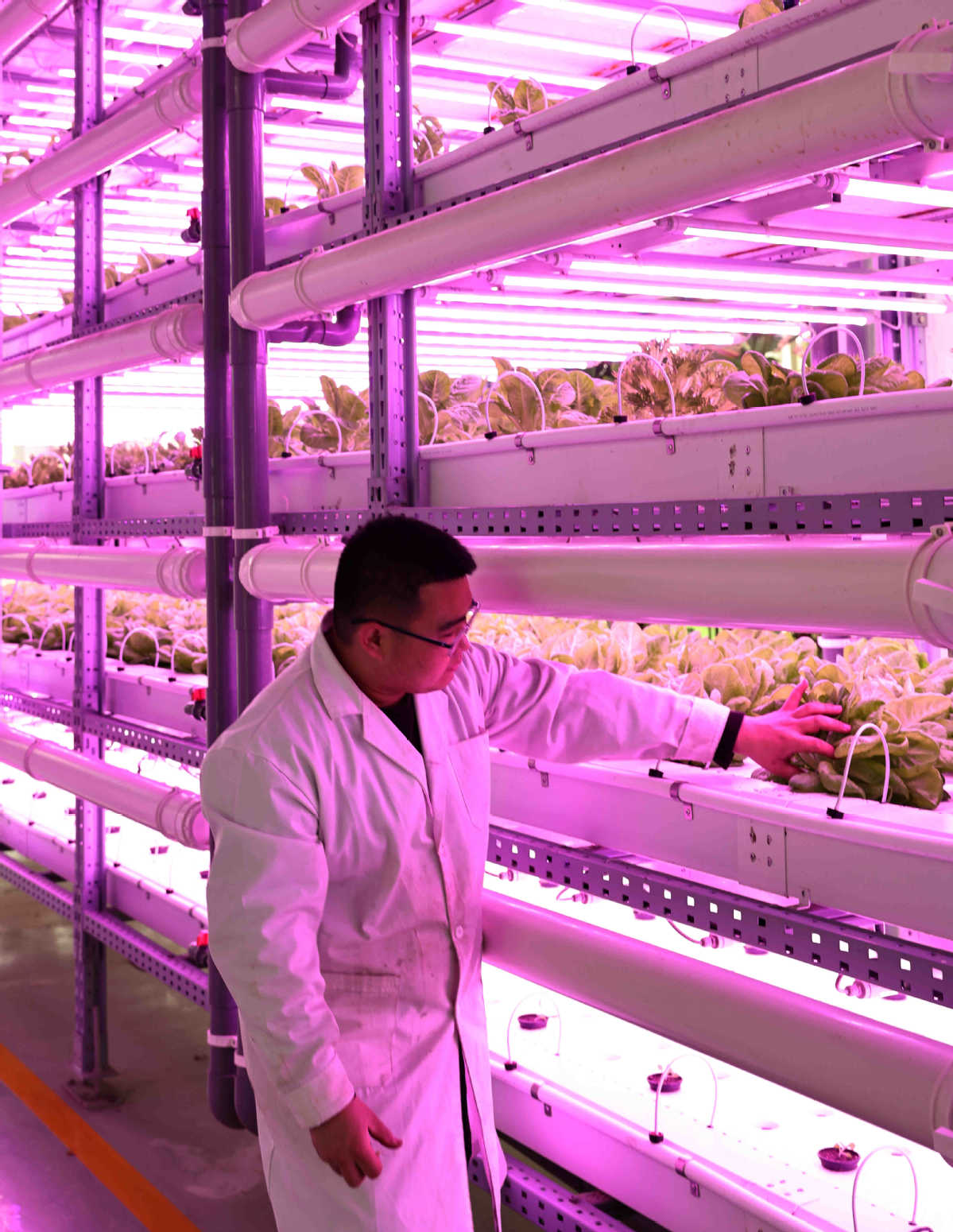
Such lighting plays a big role in the growth of green plants in places where there is insufficient sunshine. Artificial lighting can better promote crop growth by making the plants more productive, while saving a significant amount of energy.
Yang Qichang, deputy director of the Chinese Academy of Agricultural Sciences' Institute of Urban Agriculture, said that artificial lighting enables crops to be produced throughout the year, adding that the growing environment is fully controlled.
These conditions ensure the stability of crop yield to the fullest extent, Yang added.
"Vertical farming enables plants to be grown in nutrient-rich water, with the light they require supplemented by artificial sources. Some resources that are considered useless in the city can be used in vertical farming, such as sewage and carbon dioxide in the air," Yang said.
Fruit and vegetables grown indoors can resist insects and soil-borne plant diseases, as they are grown hydroponically (in sand, gravel, or liquid, with added nutrients but without soil). This method prompted Li to launch his vertical farm in northwest Beijing.
The farm's first growing season started in September. "In our first season, I expect to achieve an output value of 40 million to 50 million yuan ($5.8 million to $7.3 million) by July, and we are aiming for a turnover of 80 to 100 million yuan by 2025," Li said.
He added that 40 kg of tomatoes can be produced per sq m at his farm, with some cherry tomato varieties yielding 50 kg per sq m.