



SCO positions itself as key driver of dynamism, change









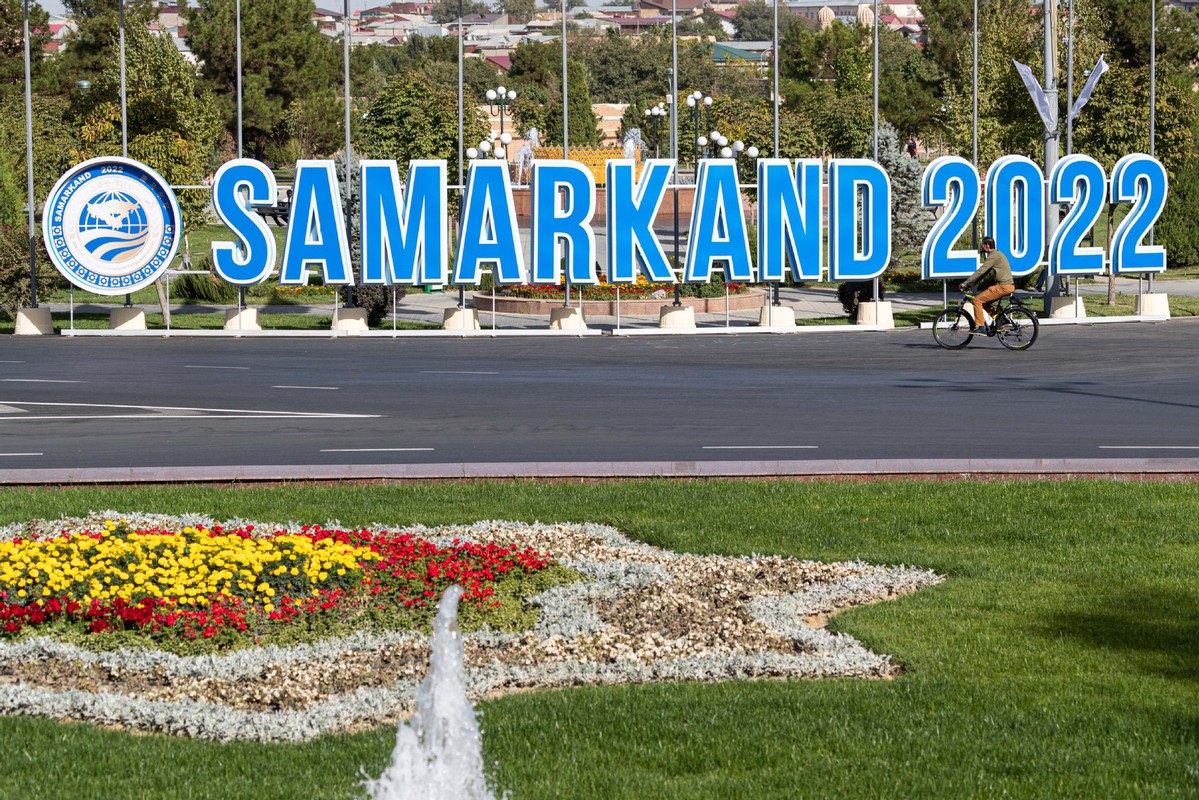
The 22nd meeting of the Council of Heads of State of the Shanghai Cooperation Organization in Samarkand, Uzbekistan, signaled dynamism and change, not only because it marked President Xi Jinping's first visit abroad since the outbreak of COVID-19, but also because its outcomes are expected to profoundly influence international relations in both the short and long terms.
In his speech at the summit on Sept 16, titled "Ride on the Trend of the Times and Enhance Solidarity and Cooperation to Embrace a Better Future", Xi said that amid the current global situation, the SCO, as an important constructive force in international and regional affairs, "should keep itself well-positioned in the face of changing international dynamics, ride on the trend of the times, strengthen solidarity and cooperation and build a closer SCO community with a shared future".
He hinted at one of the most problematic parts of the changes taking place in the international system: creating functional ties between states and regions so that they can synergize development strategies and build a shared future.
As highlighted by the tightly scheduled exchanges at Samarkand, the road to change in the international system is going to be about building trust that goes beyond the espousal of shared values as promoted by the status-quo power holders. This necessitates greater integration.
In central Asia, Turkiye can play a key role in this regard. Turkiye's participation in the summit therefore was significant, as it has potential implications for the Middle East and the international arena, especially the Eurasian region.
Broadening the scope of the SCO will naturally necessitate more inclusiveness and collaboration for investment and development, and President Xi emphasized and promoted the Shanghai Spirit, which highlights mutual trust, mutual benefit, equality, consultation, respect for diversity of civilizations and pursuit of common development.
In Xi's words, "it has been shown that the Shanghai Spirit is the source of strength for the development of the SCO as well as the fundamental guide we must continue to follow in the years to come". It was in this spirit that the 22nd SCO Summit finalized Iran's membership in the organization while moving Belarus' application to the last stage of accession.
Another important highlight of this year's event was Egypt, Saudi Arabia and Qatar being granted the status of SCO dialogue partners. Moreover, approval was given to start the process for Bahrain, the Maldives, the United Arab Emirates, Kuwait and Myanmar to be dialogue partners.
The broader embrace of the SCO shows its intention to be a constructive force that enables individual members to find solutions and build remedies for the problems in international relations.
This bears the potential for profound change, for as Turkiye has advocated in several United Nations General Assembly speeches, development and growth should not stay in the hands of an elite circle that manipulates capital flow.
It is evident that President Xi promotes collaboration and the delegation of responsibility to regional security mechanisms rather than the unipolar and superpower-centric international system. In his Samarkand speech, Xi cautioned that "the obsession with forming a small circle can only push the world toward division and confrontation".
The SCO promotes economic integrity with the support of political inclusiveness based on trust, equality and equity, thus enhancing a regional sense of unity that prioritizes the region's interests rather than those of single states.
The self-serving and hegemonic practices of the developed countries are opposed by the developing countries. China's pursuit of expanded regional security cooperation and partnerships for greener and shared development has found favor, as it will further benefit international trade and development across continents.
Turkish-Chinese rapprochement is based on common ground, as Turkiye also seeks improvement to the current security and development mechanisms.
The author is a research assistant at the Sakarya University Middle East Institute in Turkiye. The views do not necessarily reflect those of China Daily.










