



African nations don't want to choose sides









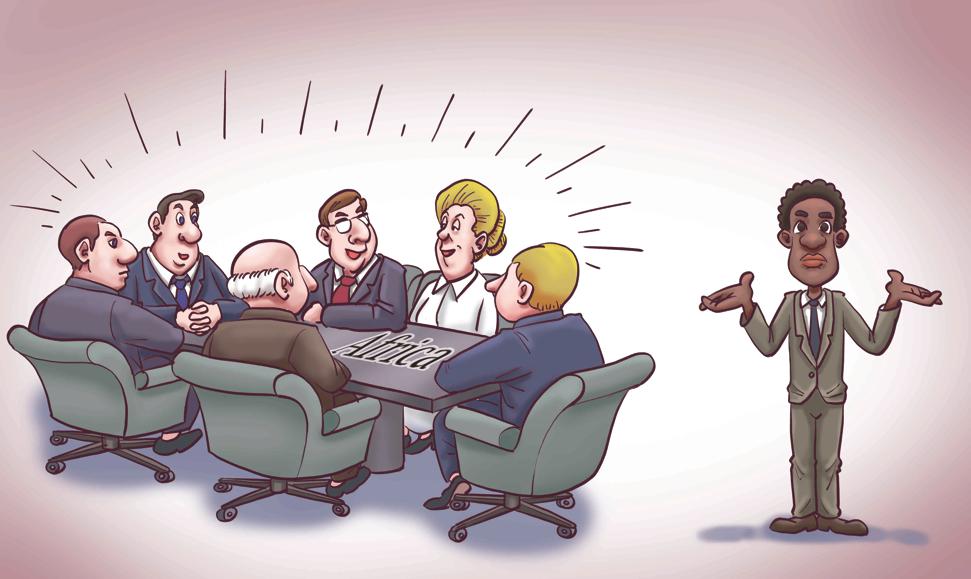
While it's too early to tell if US Secretary of State Antony Blinken's recent visit to Africa will expand US influence there, African countries also want to develop effective relations with China and don't want to be pressured into choosing sides, experts in the United States said.
"We most certainly shouldn't get into an 'us or them' posture with Africans. That creates a no-win situation for everyone concerned," Charles Ray, who is chair of the Africa Program at the US-based Foreign Policy Research Institute, and who served as US ambassador to Cambodia and Zimbabwe, told China Daily.
Blinken visited three sub-Saharan African countries-South Africa, the Democratic Republic of Congo and Rwanda-from Aug 7 to 12. The visit was built on Blinken's previous trip to Africa, but the global environment has become more complex since then.
"This context includes both intense competitions between advanced and emerging powers and the strengthened ability of countries in Africa to contribute to solving global challenges," Landry Signe, a senior fellow in the Global Economy and Development Program and the Africa Growth Initiative at the Brookings Institution, wrote in a blog.
Ray said, "My recent conversations with African intellectuals tell me that they want effective relations with both countries, and the US-China competition notwithstanding, it is to their benefit.
"I honestly believe that if both sides approach their relationships in Africa in a mature, rational manner, there is no reason the countries there can't have relations with both," he said.
During his visit, Blinken said that the US sees Africa's 54 nations as "equal partners" in dealing with global problems.
Ray said that Blinken's comment on the equal partnership with the nations of Africa is "exactly the right thing to strive for", though he added that it's too early to tell if the trip would expand US influence in Africa.
Alex Vines, director of the Africa Program at Chatham House, a policy institute based in London, said, "I think we will see more African countries not wanting to get pigeonholed and so become nonaligned."
There have been intensive, high-level visits to Africa and other diplomatic activities by a number of countries recently.
Last month, Russian Foreign Minister Sergey Lavrov visited Egypt, Ethiopia, Uganda and the Republic of Congo.
Almost simultaneously, French President Emmanuel Macron visited Cameroon, Benin and Guinea-Bissau.
Samantha Power, administrator of the United States Agency for International Development, and US Ambassador to the United Nations Linda Thomas-Greenfield also visited African countries recently.
Furthermore, according to the White House, the US will host a US-Africa leaders summit in December.
Michelle Gavin, a senior fellow for Africa policy studies at the Council on Foreign Relations, a US think tank, said in a blog that "high-level visits should signal commitment, not just competition" and warned of "two pitfalls".
"First, to make meaningful progress in advancing shared interests with African states, it's important that US officials are sincere when they deny that US attention to African partners is primarily about boxing out Russia or China," Gavin said. "The other danger is to imagine that high-level visits and emergency aid packages, in and of themselves, are enough to overcome long-festering neglect."
In recent decades, China has been investing in African countries and playing a significant role in the region. China appointed a special envoy to the Horn of Africa in January to deal with security affairs and reiterated that it would play an even bigger role for peace and stability in the region.
Ray, of the Foreign Policy Research Institute, said, "Not only do I think that the US and China can work together on some issues like climate change and its impact on Africa, but it is imperative that we do work together.
"It is not unusual for countries to disagree on certain issues, but they should not allow those differences to escalate into hostilities. We need to work on our mutual interests and manage our disagreements without becoming disagreeable. As the world's two largest economies and the two largest carbon emitters, we have a moral obligation to our people and the rest of the world to act responsibly."
Ray added that "Africa's young, fast-growing population will impact the world in coming decades, and this must be recognized by other nations like the US and China. As sovereign nations, it is (African countries') right to decide with whom they have relations."
Vines, of Chatham House, said, "I do think that (in) China-West relations, there is a prospect of working together on global issues that impact humanity."










