



Inspectors ensure rails don't fail in Kaili, Guizhou









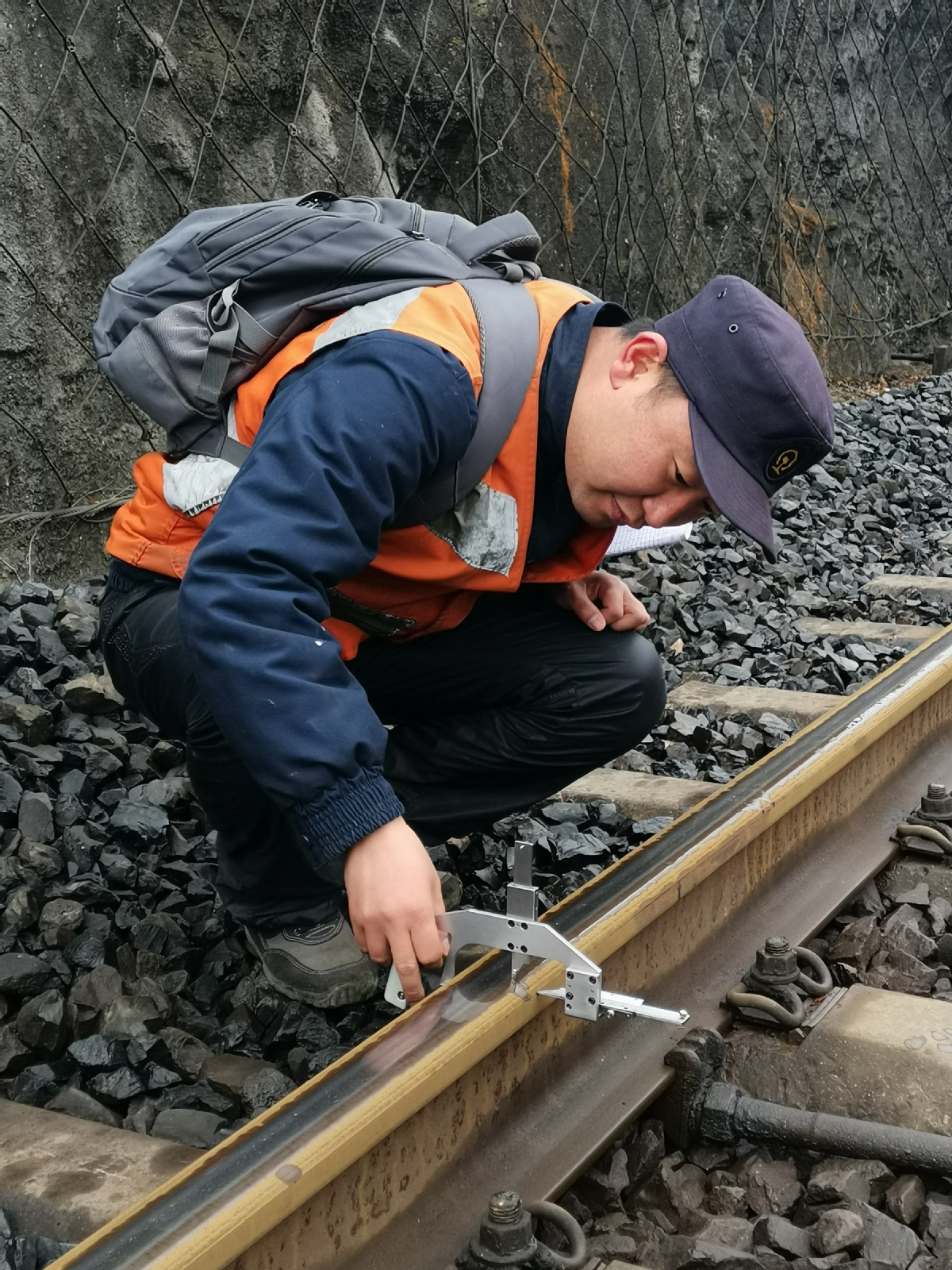
At the end of the day, people who are generally inactive would be pleased if the number on their step counters in their smartphones reached more than 10,000, which is equivalent to having walked 6 kilometers.
For Zhou Jie's, when his step counter reaches that figure, it means that he is nearing the halfway point of his daily work as a railroad inspector, a job which requires him to walk around 15 km along the railway line every day.
"I do not care about the number, because the real test is to find a defect in a few millimeters every day among a dozen km of railway tracks. An accident could happen if a little defect is undiscovered," Zhou said.
The 31-year-old is part of the 10-man inspection team that patrols the railway that runs alongside the mountains in Kaili, a city in Guizhou province. Their job is to make sure the trains can safely pass through their section.
The inspectors describe themselves as "railway doctors" whose work is just as vital as doctors in hospitals, because both types are, in their own way, responsible for saving lives.
Team members, who are age 30 on average, are always divided into two groups during the inspections. One group of three carries walkie-talkies to warn about approaching trains, while the rest scan the steel rail with flaw-detecting instruments, which use ultrasound to check for internal cracks.
Zhou is a member of the latter group. "To be more specific, we are more like gynecologists, but we hope to find nothing inside while checking," Zhou said.
Every morning, a shuttle bus takes them to their worksite-a section of the Shanghai-Kunming High-speed Railway, which runs between Huangsi and Longli county in Kaili.
After arrival, seven members of the team start conducting their routine checks, leaving the tracks when trains arrive and returning after departures. They get on and off the tracks more than 60 times a day.
"If we discover any cracks, we inform the staff at the Kaili train station, and they send people to fix it," Zhou said.
"That sounds easy, but after identifying a spot on the rails with potential damage, it demands highly concentrated attention to measure and check the flaw as well as significant stamina because we need to walk more than eight hours carrying the tool, which weighs 50 kilograms."
Meanwhile, members of the walkie-talkie group split up. One positions himself 1 km in front of the inspection team, and another 1 km behind. When they see approaching trains, they immediately inform the station and their other teammate who walks with the inspectors.
"We are important to the safety of passing trains, and the other group is important to our safety. And thanks to them, we have never experienced a frightening situation like the ones we have seen in Hollywood movies," Zhou said.
Further, the detectors have kept travelers from experiencing danger over the past few years.
"Since I became the member of this proud team in 2013, we have achieved the 'four zeros'-zero missed defects, zero miscalculations, zero violations of regulations and zero accidents-every year, and whenever I think about this, I am happy that I am here," Zhou said.
Zhou is a native of Chengde, Hebei province. After graduating from a college in Shijiazhuang, the province's capital, he got a job offer from the China Railway Chengdu Group.
The corporation, based in Chengdu, capital of Sichuan province, manages many railways sections in Southwest China, and it assigned Zhou to work at its Kaili section.
To ensure trains would operate safely during the past two Spring Festival holidays, Zhou decided to stay in Kaili instead of going back to Chengde and visiting his parents.
Last year, Zhou and his teammates inspected more than 2,500 km of lines and detected more than 100 potential dangers.
China has 18 railway group corps operating 54 railway sections, and there are inspectors working at every section.
Those inspectors in yellow vests understand that they cannot make mistakes, as doing so could be catastrophic.
"No matter what you do, you need faith to keep going. And my belief is to accomplish the 'four zeros' every day to ensure the safety of all lives on the passing trains," Zhou said.


- Authorities announce crackdown on Hanging Temple ticket scalping
- Quanzhou authority halts dismissal of teachers, student over phone incident
- Shanghai to build world's largest spokeless ferris wheel
- Chinese and Canadian universities celebrate 45 years of partnership
- Robots install solar panels at Xizang's 4,300-meter altitude project
- China's May Day holiday railway passenger trips top 100 mln





