



China, US face to face in first day talk









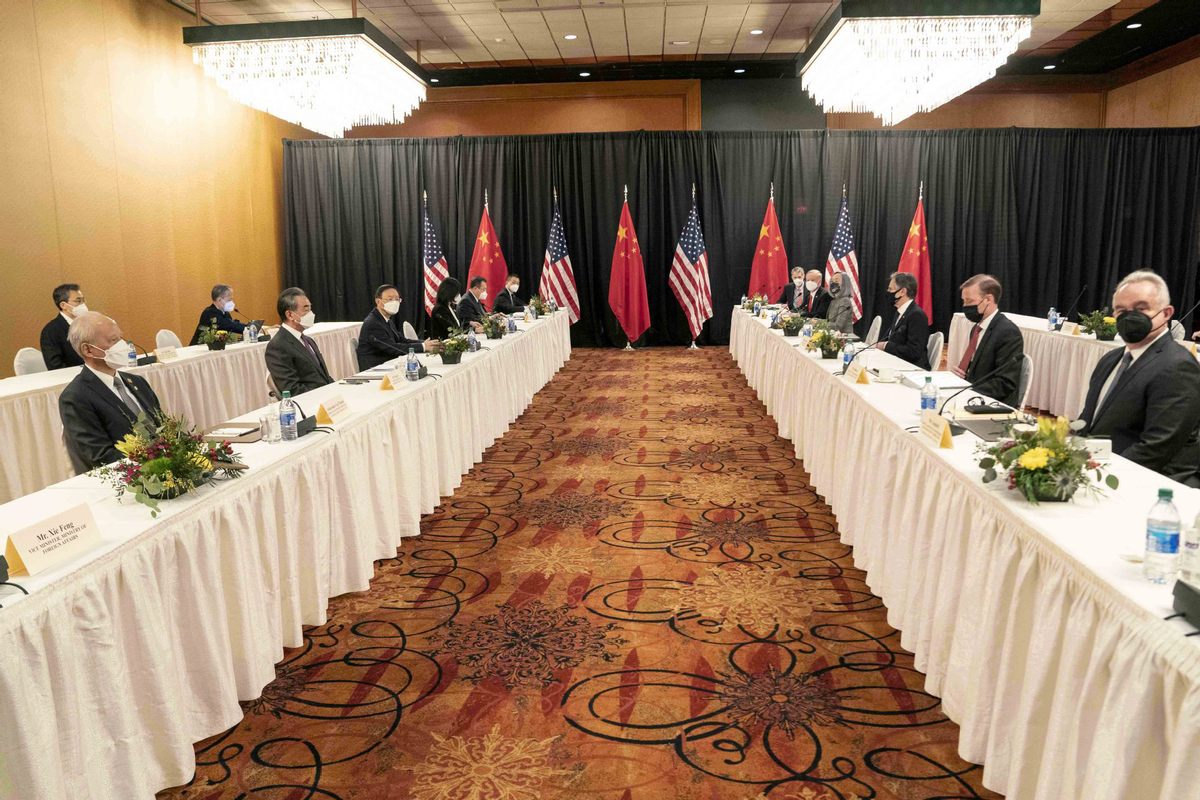
Beijing's top diplomat Yang Jiechi was bluntly sharp and unambiguous in his first vis-à-vis with senior US officials on Thursday: Don't speak to China in a condescending way, or seek to strangle the Chinese people, but work together and avoid confrontation.
Yang, a member of the Political Bureau of the Communist Party of China Central Committee and director of the committee's Office of Foreign Affairs Commission, along with State Councilor and Foreign Minister Wang Yi, met top US diplomat Antony Blinken and National Security Advisor Jake Sullivan for the first time in the Biden presidency.
Yang said at the start of his opening remarks that he hoped the dialogue will be a sincere and candid one, as it is a follow-up on the common understanding of the two presidents reached during their phone conversation about a month ago, and people hope to see practical outcomes from the dialogue.
The dialogue was scheduled to have three rounds of talks through Friday following a supposed brief opening session shortly after Thursday noon.
The tone of the US side in the opening remarks, however, prompted Yang, a former Chinese ambassador to the US, to expound China's position in an extended speech.
Blinken, who ordered sanctions on China over Hong Kong issue just two days before the meeting, talked about US "deep concerns with actions by China, including in Xinjiang, Hong Kong, Taiwan", and other areas – actions which he accused "threaten the rules-based order that maintains global stability".
Sullivan went further in his opening remarks, accusing China has undertaken an "assault on basic values".
Yang said Xinjiang, Tibet, and Taiwan are an inalienable part of China's territory, and China staunchly opposes US interference in its internal affairs. He warned that the country will take "firm actions" in response to any such interference.
"I don't think the overwhelming majority of countries in the world would recognize that the 'universal' values advocated by the US or that the opinion of the US could represent international public opinion," Yang said.
Those countries would not recognize that the rules made by a small number of people would serve as the basis for the international order, he said through an interpreter.
"What China and the international community follow or uphold is the United Nations-centered international system and the international order underpinned by international law, not what is advocated by a small number of countries of the so-called 'rules-based' international order," he said.
Unlike the US, whose arbitrary use of force has caused turmoil and instability in the world, China has followed a path of peaceful development, making "tireless efforts" to contribute to the world peace and growth, and to upholding the purposes and principles of the UN Charter.
The US has yet to deal with its own human rights and other problems and should stop finger-pointing over China's human rights and democracy, Yang said.
"The United States does not have the qualification to speak to China in a condescending way," he said. "The Chinese people do not buy it" – a colloquial saying that was translated at the scene as "This is not the way to deal with the Chinese people."
If the US wants to deal properly with the Chinese side, it should proceed from the basis of mutual respect, Yang noted.
Blinken said the US relationship with China will be "competitive where it should be, collaborative where it can be, adversarial where it must be", while Sullivan said that the US didn't want "conflict" but welcomes "stiff competition".
China and the US have had confrontations in the past, while China has pulled through the situation, the result of confrontation did not serve the US well, according to Yang.
The senior diplomat said the two countries have achieved a lot together since they forged diplomatic relations, thanks to the concerted efforts of the people with vision of both countries.
With great changes taking place in the world and under the new circumstances, Beijing and Washington need to ramp up communication, properly manage their differences, and expand cooperation instead of engaging in confrontation, he said.
History will show that one can only cause damage to himself if he wants to strangle or suppress the Chinese people, he said.
Yang listed fight against the COVID-19 pandemic, restoring global economic growth and climate change as areas for the two countries to work together and where their interests converge.
In his opening remarks, State Councilor and Foreign Minister Wang Yi denounced the latest US sanctions, which was announced just before the Chinese delegation, at the invitation of the US side, departed to the US for the dialogue.
"This is not supposed to be the way one should welcome his guests," Wang said, adding that if that was a decision made by the US to try to gain some advantage in dealing with China, it would be a miscalculation, only to expose the vulnerability and weakness inside the US.
Commenting on some countries' claim of "coercion from China" as mentioned in the opening remarks of the US side, Wang said the US should understand clearly if that was a direct complaint coming from those countries, or just the United States' own view.
If the US would indiscriminately protect and speak up for those countries just because they are allies or partners, it will then be very difficult for international relations to develop properly.
"Who is coercing whom? I think history and the international community will come to their own conclusions," he added.
The opening session of the dialogue lasted for about 70 minutes. The rest of the two-day talks were closed to the press.
The event, held in a downtown hotel in Anchorage, a remote, chilly Pacific location, was partly meant to avert the high-stakes attention in national capitals but still grabbed headlines throughout the world.










