



Sovereignty is core issue in discussing Hong Kong









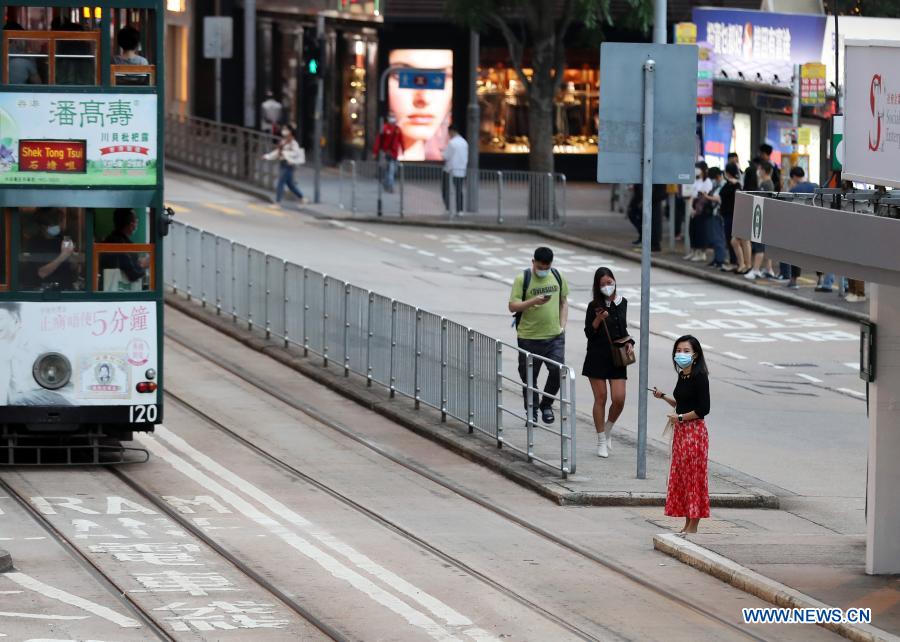
The British government announced last year that it would offer British National Overseas visas to BNO passport holders and their close family members starting in January. Beijing reacted strongly and announced that it would no longer accept the BNO passport as a travel document. Other countermeasures may also be in the pipeline.
One might say that immigration policy is the prerogative of any sovereign nation. Why should Beijing be upset? It is important to point out that ensuring national security and territorial integrity is also the prerogative of a sovereign nation.
In the Joint Declaration, the United Kingdom accepted that China has sovereignty over the Hong Kong Special Administrative Region. But the UK billed the move to offer a BNO pathway to migrate to the UK as protecting Hong Kong people from the National Security Law. This deviates from what was stated in a memorandum exchanged in December 1984 that clearly stipulated that BNO holders would not have the right of abode in the UK. The "pathway" is an affront to China's sovereignty over Hong Kong.
Surely the UK should know that national security is an important matter to any sovereign nation.
The Basic Law in force today was promulgated in 1990, and its drafting took years of consultation in Hong Kong. In Annex I of the Joint Declaration, under the "Constitution" are "establishment of the Hong Kong SAR" and "the Basic Law". We can say therefore that the Basic Law is the embodiment of the Sino-British Declaration. As long as Beijing abides by the Basic Law, it cannot be said to have deviated from the Sino-British Declaration.
Article 23 of the Basic Law clearly states that the SAR "shall enact laws on its own to prohibit any act of treason, secession, sedition, subversion against the central people's government, or theft of state secrets, to prohibit foreign political organizations or bodies from conducting political activities in the region, and to prohibit political organizations or bodies of the region from establishing ties with foreign political organizations or bodies". It is those who keep trying to block the enactment of Article 23 in Hong Kong who are the ones deviating from the Sino-British Joint Declaration.
Since China does have sovereignty over Hong Kong, and since the threat to national security has become apparent, no conscionable country should declare introducing the National Security Law an intrusion into Hong Kong's freedoms.
In a sense, it was the protesters disrupting the lives of ordinary Hong Kong people who undermined the freedom of Hong Kong people. Thus, the National Security Law also helps protect the personal safety, private property, public amenities and properties of Hong Kong residents.
The question is why Western powers are so concerned about their own national security, but at the same time completely disregard China's need for national security.
Article 45 of the Basic Law states that "the method for selecting the chief executive shall be specified in the light of the actual situation in the Hong Kong Special Administrative Region and in accordance with the principle of gradual and orderly progress. The ultimate aim is the selection of the chief executive by universal suffrage upon nomination by a broadly representative nominating committee in accordance with democratic procedures."
Although the nominating committee, which can never be dispensed with, cannot be said to be "broadly representative", the progression toward this goal will be gradual and "in the light of the actual situation" in Hong Kong.
Instead of reassuring Beijing that Hong Kong is ready for a more broadly representative nominating committee, some people led by the opposition parties asked to instead bring in "civic nomination" and "party nomination". Because these things are not in the Basic Law, Beijing could not agree to that.
Thus, it is the protesters, not Beijing, who have deviated from the Basic Law and, therefore, the Sino-British Joint Declaration. So what is Britain up to? What freedoms has Beijing taken away from Hong Kong people?
The author is a senior research fellow at the Pan Sutong Shanghai-Hong Kong Economic Policy Research Institute at Lingnan University in Hong Kong. The views do not necessarily reflect those of China Daily.





