Wine transforms desert into an oasis of wealth









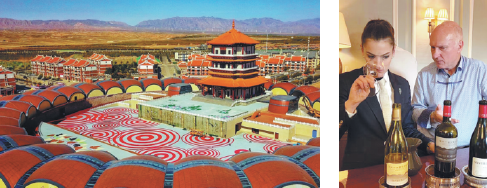
Back in 1972, the Xihaigu area in the Ningxia Hui autonomous region was deemed by the United Nations Food Development Programme as having one of the harshest natural conditions for human habitation due to its severe drought.
Today, 200,000 hectares of land at the eastern foot of Helan Mountain not far from Xihaigu is home to the vineyards of one of China's most popular wines.
It has turned itself into a paradise for winemaking, creating the famous Ningxia Helan Mountain wine region.
Zhao Shihua, deputy director of the management committee of East Helan Mountain area's wine industrial park, said as of the end of 2019 there were over 38,000 hectares of vineyards in Ningxia, accounting for a quarter of China's total.
"We've introduced some 60 plus high-quality grape varieties from home and abroad. After decades of selection and breeding, more than 20 varieties that are suitable for growing in Ningxia have been selected," Zhao said.
In recent years, Ningxia, which is considered one of the "golden areas" in the world for winemaking, has been promoting quality development of the wine industry.
The autonomous region's Party committee and government have supported the industry by pouring in a large amount of human resources and financial support.
They have set up an agency dedicated to researching industrial development and released a series of preferential policies for local wine companies.
"China is the fifth-largest wine consumer in the world and the average increase in annual consumption volume is over 20 percentage points. Last year, China consumed 920 million liters of wine, of which more than 600 million liters were imported," said Zhao Yongqing, secretary-general of the autonomous region's Party committee.
"Ningxia wine brands account for just a 4 percent share of the domestic market, meaning that it has huge potential waiting to be explored," Zhao Yongqing added.
Localized production in components such as bottles, labels and corks should also be strengthened to improve the overall development of the industrial chain, he said.
The wine industry has become a key example of Ningxia's opening-up. In 2013, the autonomous region was selected by The New York Times as one of the 46 must-see destinations in the world, because it produces China's best wine and started with grape seed planting in the desert.
Ningxia plans to host a series of wine events to further internationalize the industry.
They include the ninth International Wine Expo of Helan Mountain's East Foothill, the Concours Mondial de Bruxelles international wine-tasting event and the international competition for sommeliers.
Another strategy is to combine the wine industry with education, cultural tourism, sports, healthcare and other sectors to boost integrated growth, Zhao Yongqing said.
The autonomous region plans to establish wine-themed tourist towns with comprehensive services and tourist facilities, and carry forward research and development on wine-related healthcare products.
A construction plan for a grape culture corridor at East Helan Mountain has also been compiled by the local government.
Ningxia's wine industry also serves as a key stimulus for local poverty alleviation and environmental protection.
Notable improvements are taking place in local people's lives and in the quality of the environment. During the development process, more than 26,600 hectares of green land has been added to production areas.
Also, more than 23,300 hectares of wasteland is being transformed for development.
The process has created employment for 120,000 people every year, helping many local farmers lift themselves out of poverty.
"Wine grapes have become an important industry for Ningxia to expand its opening-up to the outside world, adjust its structure, and transform and upgrade," Zhao Shihua said.




- Chinese court announces 1st-instance verdict for fraud gang in northern Myanmar
- China aligns green finance with global standards, boosting renewable leadership
- Xu Faqi sentenced to death with a two-year reprieve
- Shanghai researchers unveil promising clinical trial results in glioblastoma treatment
- CCG organizes 134 patrols around the Diaoyu Islands since 2021
- Yangtze finless porpoise population increases in China