



Trump to halt work visas through 2020









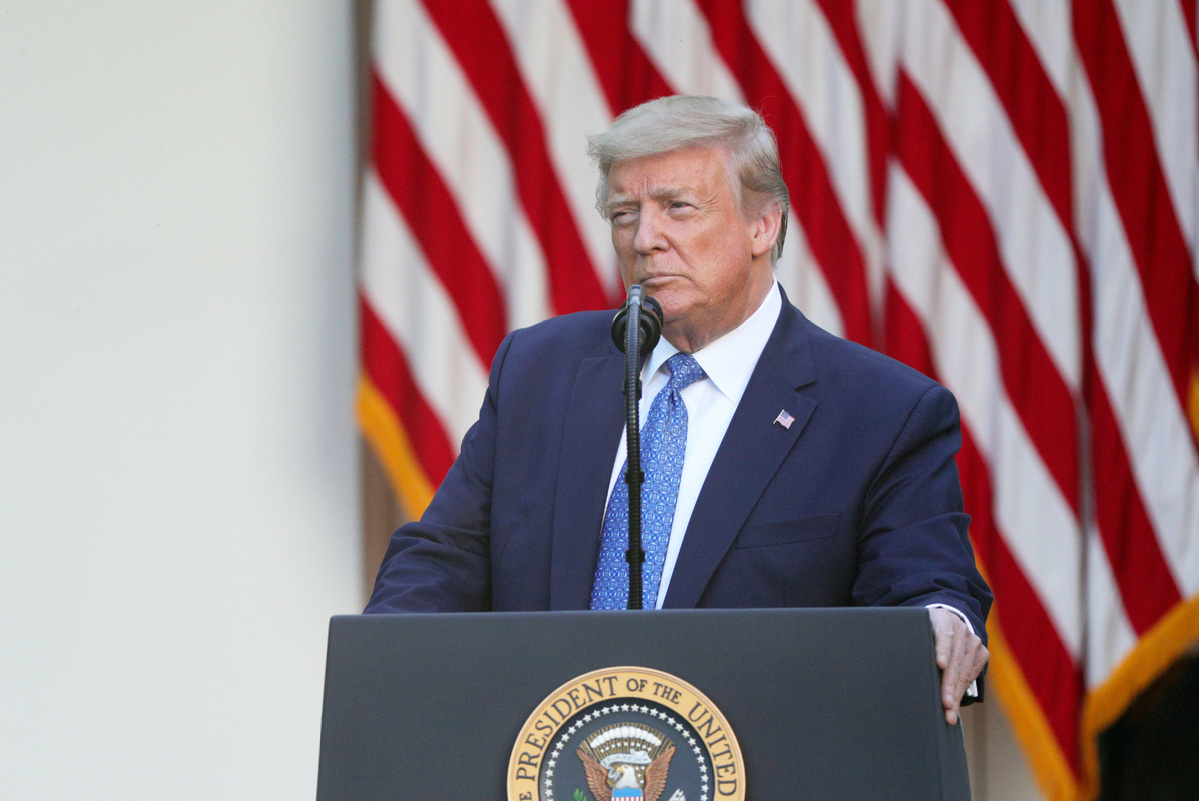
US President Donald Trump on Monday signed an executive order to suspend the issuance of certain temporary worker visas through the end of 2020, a move that critics said would hurt the country's tech industry.
Trump's latest effort to crack down on immigration follows his measure in April to temporarily suspend immigration to the US, which he said was aimed at protecting American jobs affected by the COVID-19 pandemic.
The new order extends his earlier ban through Dec 30 and expands it by imposing restrictions on a variety of work visas, including the categories H-1B, H-2B, H-4, L-1 and certain J-1 visas.
H-1B visas are designed for highly skilled workers, particularly in the tech industry. It is the largest visa program of those included in Monday's order.
"Immigration is essential to the success of America's innovation economy. In Silicon Valley, nearly 60 percent of STEM (science, technology, engineering and math) workers with a bachelor's degree or higher are foreign-born," Peter Leroe-Mu?oz, general counsel and vice-president of tech and innovation policy at the Silicon Valley Leadership Group, told China Daily.
The president's immigration ban impedes companies, universities and research institutions from attracting and retaining top global talent, said Leroe-Mu?oz, whose organization represents nearly 400 Silicon Valley firms.
Trump's initial order was strongly opposed by those in the tech industry, who said it would harm their efforts to recruit for positions that do not have a strong applicant pool among US citizens.
In the short term, the expanded visa restrictions will make it harder for Silicon Valley companies to fill tech positions that were vacant before the current novel coronavirus pandemic, said Leroe-Mu?oz.
"In the long-term, tech companies in the region will be faced with reduced opportunities for innovation, as smart, hard-working immigrants relocate to other countries and compete against American businesses," he said.
Over the past few years, the Trump administration has taken a series of measures to crack down on the H-1B program, including short-term H-1B approvals and a policy that requires employers to submit itineraries detailing H-1B visa holders' work.
Trump also has instructed his aides to begin work on long-term reforms to the immigration system, including changing the H-1B distribution system. Currently H-1B visa applicants are required to go through a lottery process before they submit full applications. The new approach was criticized by Leroe-Mu?oz as "backward" and "inefficient".
The Trump administration has also increased the denial rate for H-1B visas to a record high. Denials more than tripled to 15.2 percent in 2019 from 4.3 percent in 2015.
Other types of jobs affected by Monday's order include H-4 visas given to spouses of H-1B visa holders; H-2B visas used by seasonal workers, such as in the construction and hospitality industries; L-1 visas for executives who work for large corporations; and J-1 visas for academic and cultural purposes.
Immigration advocates criticized Trump for targeting immigrants for domestic political reasons.
"There has been a steady effort by the Trump administration to completely shut down immigration to the United States for the past three years. It is no surprise they are using the coronavirus as a pretext to advance this agenda," said Beth Werlin, executive director of the American Immigration Council, following the initial order in April.
Immigrants are essential to the US, particularly during a health crisis, said Congresswoman Judy Chu, a California Democrat, as an estimated 6 million immigrants are working in essential jobs, such as healthcare, grocery, retail and cleaning services.
"Immigrants make up 28 percent of doctors and surgeons in the US and 24 percent of nurses and home aides," she said, "so it's obvious that immigrants are so vital to this nation and to our recovery."










